Abstract
Systems and methods for integrated video information delivery combine a proactive pathway and a reactive pathway operating concurrently during playing of a video. A neural network identifies noteworthy items within a video responsive to first principles, generates a video map, and derives a customized video map responsive to a viewer interest profile. The proactive pathway surfaces information icons at video playing locations corresponding to noteworthy items and delivers map information upon viewer activation. The reactive pathway receives viewer information requests, captures a video playing location, and delivers map information where available and sufficient and global information retrieved through real-time information search where map information is unavailable or insufficient. Both pathways evaluate a shopping option, surface a shopping icon, record a purchase proximity signal, and resume playing responsive to a resume condition. A presentation list comprising subject presentations is delivered following completion of playing of the video.
Terms And Definitions
For purposes of the present disclosure, various terms used in the art are defined as follows:
The term “exemplary” shall mean “serving as an example, instance, or illustration.” Any aspect or embodiment described herein as “exemplary” is not necessarily to be construed as preferred or advantageous over other aspects or embodiments described herein.
The term “herein” shall mean in the entirety of this specification including drawings, abstract, and claims. The term herein is not limited to the paragraph, section, or embodiment in which it may appear.
The terms “include”, “comprise”, and “contains” do not limit the elements to those recited. By contrast, only the term “consist” limits the elements to those listed. Unless specifically stated otherwise, the term “some” refers to one or more.
The term “responsive” does not limit the elements, conditions, and/or requirements that may be taken into consideration. For example, an element or structure that is responsive to a specified requirement is not limited to being responsive to only that specified requirement. An element or structure may be responsive to a specified requirement and a second non-specified requirement, specially, when the second requirement, while described as an alternative requirement, may be also deemed complementary.
The term “such as” shall mean "including but not limited to" and introduces non-exhaustive illustrative examples that do not limit the scope of the disclosure.
No conceptual distinction should be drawn from the use of the terms on, at, or in.
The term "applicable first principles" shall mean first principles selected as relevant to a specific video.
The term "associated" shall mean associated, linked, related, connected, brought into relationship, joined, designated, ascribed, or attributed.
The term "commercial placement" shall mean an item appearing within a video in connection with a commercial arrangement.
The term "customized video map" shall mean a video map adapted to a viewer interest profile.
The terms "descriptors" and "keywords" shall mean words, terms, phrases, designations, codes, labels, data, metadata, numbers, or other information that identifies, describes, categorizes, or provides information.
The term "enrichment layer" shall mean the portion of a video map derived from sources external to the video.
The term "explicit item preferences" shall mean viewer item preferences provided directly by the viewer.
The term "feature-length movie" shall mean a video of forty minutes or longer duration.
The term "first principles" shall mean fundamental principles that exist independently of any specific video, viewer population, or prior observation.
The term "first screen implementation" shall mean a deployment configuration in which video and related information are presented on a single display device.
The term "global information" shall mean information retrieved, externally from a video map, through a real-time information search.
The term "icon" shall mean an indicator comprising one or more of a visual indicator and an auditory indicator, signaling availability of one or more of information and a commercial option.
The term "implicit item preferences" shall mean viewer item preferences derived from viewer behavior without requiring deliberate viewer specification.
The term "independent derivation" shall mean the derivation of item salience characteristics from first principles by a neural network.
The term "inferred placement" shall mean a commercial placement designation assigned to an item responsive to structural signal analysis of the video independent of contractual data.
The term "information delivery" shall mean the delivery of one or more of responsive information, map information, global information, subject presentation, and a presentation list, to a video display apparatus.
The term "information icon" shall mean a visual indicator presented signaling that information is available responsive to a video playing location.
The term "information presentation constraint" shall mean a constraint on information presented to a viewer responsive to the viewer's position within a video.
The term "information suitability determination" shall mean the determination of alignment between item salience characteristics and a viewer interest profile.
The term "interest match score" shall mean the output of the information suitability determination representing the degree of alignment between item salience characteristics and a viewer interest profile.
The term "item" shall mean any item, product, object, property, act, or information appearing within a video, whether or not offering a commercial, purchase, informational, or entertainment opportunity.
The term "item identity resolution" shall mean the process of enabling consistent tracking of an item across multiple depictions within a video.
The term "item salience characteristics" shall mean characteristics of an item derivable from analysis of a video.
The term "item salience layer" shall mean the portion of a video map derived from analysis of the video.
The term "map information" shall mean information retrieved from a video map.
The term "neural network" shall mean any one or combination of artificial neural networks, deep learning systems, convolutional neural networks, recurrent neural networks, transformer architectures, large language models, machine learning systems, and other computational learning systems.
The term "noticeable" shall mean the property of an item that a viewer could detect within a video frame.
The term "noteworthy" shall mean the property of an item whose presence within a video, evaluated across the totality of its depiction, generates a viewer information-seeking response probability exceeding a threshold derivable from first principles.
The term "nuanced calibration" shall mean supplementary analysis responsive to systematic divergence identified through validation.
The term "objectively valuable characteristics" shall mean characteristics of content items possessing value independent of viewer interaction.
The term "operating conditions" shall mean contextual factors affecting information delivery to a viewer during a viewing session.
The term "presentation list" shall mean a list comprising one or more of subject presentations, item identifications, item purchase information, and information responsive to identified items.
The term "production quality assessment" shall mean the classification of a video according to objective technical production characteristics.
The terms "providing", "surfacing", and "display", when used with respect to an icon, shall mean providing an icon.
The term "purchasable item" shall mean an item available for acquisition by a viewer.
The term "real-time information search" shall mean an information search contemporaneously conducted responsive to a viewer information request.
The term "responsive information" shall mean information possibly responsive to a viewer information request.
The term "resume condition" shall mean a condition requiring resumption of a playing of a video.
The term "salience" shall mean the property of an item, derivable from first principles, that renders the item noteworthy within the video in which it appears.
The term "second screen implementation" shall mean a deployment configuration in which a video display device and a companion device each serve distinct display functions.
The terms "segment" and "video segment" shall mean one or more video frames.
The term "session-level aggregation" shall mean the accumulation of noteworthy items identified across multiple videos consumed within a single viewing session.
The term "shopping icon" shall mean a visual indicator presented signaling that item purchase information is available responsive to a video playing location.
The term "spoiler avoidance constraint" shall mean a constraint on information presented to a viewer responsive to the viewer's position within a video.
The term "structure and objectives specification" shall mean a specification of the structural characteristics and objectives governing item identification within a video.
The term "subject presentation" shall mean curated combination segments extracted from within the video focusing on the presentation of at least one item.
The term "totality of depiction" shall mean the complete history of an item's appearances within a video evaluated cumulatively.
The term "typed salience classification" shall mean a designation assigned to a noteworthy item reflecting the category of viewer information-seeking response the item is likely to generate.
The term "validation" shall mean a comparison of neural network derived item salience characteristics against an independent reference.
The term "video" shall mean any combination of visual elements, audio elements, or both, constituting a presentation.
The terms "video" and "video program" shall be interchangeable.
The term "video map" shall mean a data structure associating at least one video playing location within a video with information.
The term "video playing location" shall mean a location within a playing of a video identified by one or more of a time stamp, frame identification, and clip definition.
The term "viewer" shall mean a person consuming a video, and shall be interchangeable with the terms "player", "subscriber", and "user".
The term "viewer identification" shall mean the process by which the system establishes the identity of a viewer.
The term "viewer information request" shall mean any explicit or inferred indication of viewer interest in information responsive to a video being viewed, comprising one or more of a viewer-issued voice command, a viewer-issued text or touch input, a viewer behavioral signal from which information-seeking intent is derivable, and an AI-inferred determination of viewer interest responsive to observed viewer behavior.
The term "viewer interest profile" shall mean a representation of a viewer's receptivity to content items.
The term "viewer item preferences" shall mean a viewer's preferences with respect to items.
The term "viewer position tracking" shall mean a mechanism maintaining a record of a viewer's current position within a video applied as a constraint on information presentation.
Where definitions, terminology, or technical descriptions differ between the incorporated references and the present application, the present application controls. An element described in the incorporated references may be combined with elements described in the present application to create embodiments not explicitly detailed in either individually. Incorporation by reference shall not act to modify, limit, or broaden the definitions hereinabove provided or formally defined in this document. A term that is not formally defined in this document is defined herein to have its ordinary and customary meanings.
First Principles Foundations.
The systems and methods disclosed herein rest upon a foundation of first principles governing the identification of noteworthy items within videos, the derivation of viewer interest profiles, the determination of information suitability, and the delivery of information responsive to noteworthy items through both the proactive pathway and the reactive pathway. First principles constitute fundamental truths derivable from the objective laws governing human perception, cognition, narrative comprehension, consumer motivation, social behavior, linguistic processing, and audiovisual production that remain constant and do not require learning, improvement, or evolution through system operation. The first principles knowledge base organizes these truths across eight domains: perceptual psychology, narrative semiotics, consumer psychology, social psychology, acoustic-visual integration, natural language semantics, cognitive architecture, and production grammar. The neural network identifies applicable first principles from the first principles knowledge base responsive to the structure and objectives specification, derives item salience characteristics responsive to the applicable first principles, and identifies noteworthy items within a video responsive to the item salience characteristics, all without requiring prior interaction data, domain-specific training examples, or human judgment at any stage. The constancy of first principles is what enables the system to deliver information responsive to noteworthy items to new viewers, for new videos, and across content domains without requiring prior interaction history: because the principles governing viewer information-seeking responses to video content are derivable from the objective architecture of human perceptual, cognitive, and motivational systems rather than from statistical approximation of historical viewer behavior, the system's derivations are valid for any viewer and any video to which the applicable first principles apply.
Constancy of First Principles. First principles do not change through system operation. What adapts during system operation is the neural network's accuracy in applying constant first principles to specific video structures and viewer information requests, not the principles themselves. The first principles knowledge base may be updated through deliberate revision by domain experts to incorporate advances in perceptual psychology, narrative theory, consumer psychology, social psychology, acoustic-visual integration research, natural language semantics research, cognitive science, or production design scholarship, but such updates reflect advances in human understanding of constant principles rather than modifications to the principles themselves driven by system operational experience. This constancy is the architectural property that distinguishes first principles derivation from data-driven approximation: a data-driven system that has processed one million videos has learned something that a system that has processed ten videos has not, because its derivations are statistical artifacts of the training corpus rather than derivations from principles that are equally valid regardless of the volume of prior observation. The neural network of the present invention, applying first principles constraints to the video's structural signals, produces item salience characteristics derivations of equivalent validity for the first video it processes as for the ten-thousandth, because the first principles from which those derivations proceed are not properties of the training corpus but properties of human perceptual and cognitive architecture that exist independently of any corpus.
Perceptual Psychology. First principles of perceptual psychology govern the identification of item salience characteristics derivable from the visual and acoustic structure of a video that are relevant to the generation of viewer information-seeking responses. Human visual attention is not uniformly distributed across a video frame but is systematically directed by structural properties of the visual scene that operate independently of semantic content recognition. Spatial prominence characteristics govern the distribution of visual attention across a video frame as a function of an item's position, size, and relationship to the frame's compositional structure, with items occupying positions of compositional centrality, golden ratio alignment, or rule-of-thirds intersection generating attentional capture at rates derivable from first principles of visual composition independent of the item's identity or semantic category. Contrast-based attentional capture characteristics govern the attentional salience generated by luminance, chromatic, and edge-contrast differentials between an item and its background, with high-contrast items generating attentional capture proportional to contrast magnitude as a fundamental property of the human visual system's edge-detection and figure-ground segregation architecture. Motion salience characteristics govern the attentional priority assigned to moving items within a visual scene, reflecting the evolutionary basis of the human visual system's motion detection sensitivity as a property of low-level visual processing that precedes semantic recognition and operates independently of item identity or content. Figure-ground prominence characteristics govern the attentional salience generated by the perceptual separation between an item as figure and its visual context as ground, with items exhibiting strong figure-ground separation generating attentional capture at rates derivable from first principles of Gestalt perceptual organization.
Object recognition under degraded item depiction conditions is governed by first principles of visual object recognition that enable the neural network to identify the subject of a viewer information request at a captured video playing location where item depiction conditions are impaired by partial occlusion, unfavorable viewing angle, low contrast between the item and its background, motion blur arising from camera or item movement, or low lighting conditions. The principles governing human visual object recognition under degraded conditions establish that identity resolution is achievable through partial feature matching, viewpoint-invariant shape representation, and contextual constraint satisfaction, enabling the system to apply item identity resolution to identify an item across appearances varying in viewpoint, scale, occlusion, and lighting as the same item. Where item depiction conditions at the captured video playing location impair confident item identification, the system may evaluate item appearances at video playing locations adjacent to the captured video playing location under more favorable depiction conditions, applying the first principles of object identity constancy to confirm the item's identity across adjacent appearances.
Multimodal attentional amplification is governed by first principles of multisensory perception establishing that simultaneous salience signals across multiple perceptual channels generate attentional capture exceeding the sum of the individual channel contributions, reflecting the human perceptual system's cross-modal binding architecture. An item whose visual prominence is simultaneously accompanied by acoustic reinforcement through verbal reference, musical emphasis, or sound design generates a multi-channel convergence salience signal whose attentional capture magnitude is derivable from first principles of multisensory integration independently of the item's semantic category or identity. Auditory-visual attentional channel separation is governed by first principles establishing that the human perceptual system maintains partially independent attentional resources for visual and auditory processing, enabling information delivered through the audio reproduction of a video display apparatus to be received and processed without requiring reallocation of visual attentional resources directed to the video, such that auditory information delivery does not disrupt visual engagement with the video content in the manner that visual information delivery does.
Narrative Semiotics. First principles of narrative semiotics govern the identification of item salience characteristics derivable from an item's structural position within the narrative of a video that are relevant to the generation of viewer information-seeking responses independently of the item's visual salience characteristics. Character-object association dynamics establish that items consistently associated with a named or recurring character within a video accumulate aspirational and identity-expressive salience proportional to the viewer's emotional investment in the character, reflecting the fundamental narrative semiotic principle that objects acquire meaning through their structural relationship to the subjects who possess, use, or covet them within a narrative. An item worn or carried by a protagonist character across multiple scenes accumulates character-association salience through each appearance, generating a narrative-cumulative salience that is a derivable property of the item's structural position within the narrative rather than of its visual characteristics in any single frame.
Narrative arc structure and the distribution of viewer emotional investment establish that viewer information-seeking responses to noteworthy items are modulated by the item's position within the narrative arc of the video, with items appearing at narrative positions of elevated emotional investment generating higher information-seeking response probabilities than items appearing at narrative positions of low emotional investment, as a derivable property of the relationship between narrative position and the transfer of emotional valence from character experience to associated items. Scene-type salience modulation establishes that the salience of items within a video is modulated by the scene type in which they appear, with scenes of intimate character interaction, aspirational lifestyle display, and commercial activity generating higher item salience transfer than scenes of action, conflict, or exposition, as a derivable property of the narrative contexts in which item-to-viewer aspiration transfer is most effectively encoded. Thematic recurrence establishes that items appearing across multiple scenes in a video accumulate salience through thematic recurrence independently of their per-appearance visual salience characteristics, reflecting the narrative semiotic principle that repetition within a narrative encodes intentional emphasis that is a derivable signal of the item's narrative significance.
The spoiler avoidance constraint is grounded in the first principles of narrative consumption psychology establishing that the viewer's information-seeking response to a video is governed by a psychological contract of narrative discovery under which the viewer expects to encounter narrative developments in the sequence intended by the narrative's author, and that the premature delivery of information revealing narrative developments the viewer has not yet encountered constitutes a violation of this contract generating experiential harm that the system is architecturally designed to prevent. The spoiler avoidance constraint applies to information delivery through both the proactive pathway and the reactive pathway, governing icon surfacing, map information delivery, and global information processing to ensure that no information delivered to a viewer references narrative developments at video playing locations subsequent to the viewer's current video playing location. In episodic video content, the spoiler avoidance constraint applies across episodes, ensuring that items and information from episodes the viewer has not yet viewed are not surfaced during viewing of prior episodes. Narrative re-engagement psychology establishes that a viewer who resumes playing of a video at a video playing location preceding the paused video playing location following an information delivery re-encounters the item in its narrative context enriched by the information received, generating a reinforcement of the association between the item's narrative significance and the viewer's information-seeking and commercial engagement response that is a derivable property of narrative re-exposure under conditions of enhanced item identification.
Consumer Psychology. First principles of consumer psychology govern the derivation of viewer interest profiles representing viewer receptivity to content items, the information suitability determination determining the degree of alignment between item salience characteristics and viewer interest profiles, and the shopping icon and purchase proximity signal architecture of the shared delivery system. Aspiration dynamics establish that viewer receptivity to items depicted in videos is substantially governed by the aspirational value the viewer attributes to the item as a vehicle for identity expression, social signaling, and lifestyle association, and that this aspirational value is transferable from the narrative context in which the item is depicted to the viewer's own identity and lifestyle aspirations as a derivable property of the human motivational architecture governing self-concept and ideal-self formation. Items depicted in association with characters whose identity attributes the viewer aspires to embody generate aspirational transfer salience that is a derivable property of the alignment between the character's depicted identity attributes and the viewer's ideal-self representation, independently of the item's intrinsic properties.
Economic receptivity is a dimension of viewer receptivity to content items derivable from first principles of consumer psychology governing price-tier self-categorization, aspiration ceiling, and commercial engagement propensity. Economic receptivity represents the viewer's capacity and propensity to engage commercially at specific price points within each item category, and governs which price tier within the commercial ecosystem of a noteworthy item is delivered to the specific viewer through the information suitability determination. Price-tier self-categorization establishes that viewers maintain implicit self-categorizations with respect to the price ranges within which commercial engagement is consistent with their economic self-concept, and that commercial information delivered outside the viewer's economic receptivity range generates rejection responses that are counterproductive to commercial engagement independent of the item's aspirational value. Aspiration ceiling establishes that the aspirational value of an item is modulated by the viewer's assessment of its economic accessibility, with items perceived as economically inaccessible generating reduced aspiration transfer relative to items perceived as economically accessible at the viewer's economic receptivity tier. Economic receptivity is derivable from one or more of viewer demographics, viewer stated preferences, behavioral signals comprising prior transaction engagement events and price point interaction history, and longitudinal data accumulated across prior viewing sessions, and is updated responsive to shopping icon activation and non-activation events, purchase decision signals, purchase proximity signals, and presentation list commercial engagement events.
The sequential information-to-intent-to-action pipeline establishes that commercial intent responsive to a depicted item is more effectively generated through a sequential process in which information delivery precedes commercial presentation than through simultaneous information and commercial presentation, as a derivable property of the consumer decision-making architecture governing the progression from item awareness through item identification and contextual understanding to commercial intent and transaction-seeking behavior. The shopping icon architecture of the present invention implements this pipeline by surfacing a shopping icon to a viewer at the conclusion of an information delivery rather than simultaneously with it, ensuring that the viewer has received item identification, cultural and contextual information, and narrative significance before being presented with a commercial acquisition opportunity. The information delivery establishes the item's identity and value proposition in the viewer's cognitive representation before the shopping icon presents the acquisition pathway, generating commercial intent through informed desire rather than through uncontextualized commercial stimulus.
Social Psychology. First principles of social psychology govern the social dynamics of information-seeking behavior in shared viewing contexts and the system's architecture for delivering information effectively across both individual and shared viewing contexts. Shared viewing context dynamics establish that the behavior of individual viewers within a shared viewing context is governed by social norms regulating individual expression of interest, preference, and commercial intent in the presence of other viewers, and that these norms generate social signaling costs associated with behaviors that expose individual viewer interests to other viewers present. The social suppression mechanism establishes that viewer information-seeking behavior through the reactive pathway -- comprising viewer-issued voice commands, text or touch inputs, and other explicit interaction modalities -- is subject to social suppression in shared viewing contexts, as the activation of the reactive pathway requires the viewer to perform a visible or audible action that signals individual information-seeking interest to other viewers present, generating social signaling costs that inhibit reactive pathway activation independently of the viewer's interest in the item. The social signaling cost of reactive pathway activation is highest at moments of shared emotional engagement with the video content, as interrupting a shared emotional moment to issue a viewer information request exposes individual commercial interest at the precise moment when collective narrative engagement is the dominant social norm.
The proactive pathway's information icon architecture eliminates the social signaling cost of information-seeking in shared viewing contexts by surfacing information icons without requiring any viewer action to initiate the icon surfacing, enabling a viewer in a shared viewing context to observe an information icon's availability without performing any action that signals individual information-seeking interest to other viewers present. The viewer's decision to activate a surfaced information icon remains a private decision that may be deferred to a companion device in a second screen implementation, further reducing the social signaling cost of information-seeking in shared viewing contexts. The proactive pathway therefore reaches viewers whose information-seeking responses are socially suppressed in shared viewing contexts at the precise moments -- narrative peaks of shared emotional engagement with aspiration-transferring item depictions -- when social suppression of the reactive pathway is strongest, delivering information and commercial engagement opportunities that the reactive pathway cannot deliver in these contexts. In multiple simultaneous viewer contexts, each viewer in a shared viewing context may receive individually personalized information delivery through a respective companion device in a second screen implementation, enabling each viewer to receive information delivery calibrated to their individual viewer interest profile without exposing individual interest to other viewers present.
Acoustic-Visual Integration. First principles of acoustic-visual integration govern the identification of item salience characteristics derivable from the convergence of visual and acoustic signals within a video that are relevant to the generation of viewer information-seeking responses. Cross-modal convergence establishes that the simultaneous elevation of salience signals across the visual and acoustic processing streams for the same item at the same video playing location generates a convergent salience signal whose magnitude exceeds the sum of the individual stream contributions, as a derivable property of the human perceptual system's cross-modal binding architecture that assigns elevated attentional priority to stimuli whose properties are simultaneously reinforced across multiple sensory channels. Verbal reference reinforcement establishes that an item's visual salience is amplified when the item is simultaneously referenced by name, description, or category in the video's dialogue or narration, as the acoustic verbal reference activates the item's semantic representation through the language processing system simultaneously with its visual representation through the perceptual system, generating a cross-modal convergence signal that is a derivable property of the human brain's audiovisual speech-object binding architecture.
Musical association establishes that items depicted in association with distinctive musical themes, motifs, or production music generate acoustic-visual association salience through the conditioning of the acoustic stimulus to the item's visual representation, such that subsequent appearances of the musical theme generate anticipatory attentional orienting toward the associated item as a derivable property of auditory-visual associative learning. Sound design emphasis establishes that items highlighted through deliberate sound design -- comprising diegetic sound amplification, sound effect association, or silence-contrast emphasis -- generate acoustic-visual convergence salience through the deliberate production decision to encode the item's significance through acoustic as well as visual channels, reflecting the production grammar principle that deliberate multi-channel encoding is a signal of intentional item emphasis. The acoustic reinforcement stream of the neural network's multi-stream processing architecture processes verbal reference signals, musical association signals, and sound design emphasis signals synchronized with item appearances to derive acoustic-visual integration item salience characteristics that contribute to the item's overall item salience characteristics and to the convergence score computed by the cross-modal attention mechanism.
Natural Language Semantics. First principles of natural language semantics govern the identification of responsive information responsive to a viewer information request and a captured video playing location, enabling the neural network to resolve the subject of a viewer information request against the visual characteristics of the video playing location through first principles analysis of the semantic relationship between the request and the item salience characteristics of the depicted items. Semantic distance minimization establishes that the subject of a viewer information request is identifiable as the item at the captured video playing location whose visual and contextual characteristics minimize the semantic distance to the request's semantic content, where semantic distance is a derivable measure of the degree to which the item's identity, category, attributes, and contextual associations satisfy the semantic content of the request. A viewer information request of the form "what is that necklace" generates a semantic distance minimization computation across items visible at the captured video playing location, with the item whose identity, category, and visual characteristics most completely satisfy the semantic content of the request identified as the most probable subject, as a derivable property of the relationship between natural language semantic content and visual object representation.
Temporal offset derivation establishes that a viewer information request may be issued at a video playing location subsequent to the video playing location at which the item generating the request appeared, as a derivable property of the cognitive processing dynamics governing the viewer's formulation and issuance of a viewer information request responsive to an item appearance. The delay between an item's appearance in the video and the viewer's issuance of a viewer information request responsive to that appearance reflects the cognitive processing time required for the viewer to identify the item as a subject of information-seeking interest, formulate the information request, and execute the request through the applicable interaction modality. The temporal offset between the item's appearance and the viewer information request issuance is derivable from first principles of viewer cognitive processing dynamics and is applied by the system to evaluate item appearances at video playing locations preceding the captured video playing location when resolving the subject of the viewer information request. Referential resolution establishes that viewer information requests referencing items through pronouns, ellipsis, partial descriptions, or prior conversational context are resolvable against the visual characteristics of the captured video playing location and the history of prior viewer information requests within the viewing session through first principles of natural language referential semantics governing anaphora resolution, ellipsis interpretation, and conversational context tracking.
Cognitive Architecture. First principles of cognitive architecture govern the operating conditions analysis, hierarchical consequence optimization, predictive viewer engagement state modeling, and strategic information delivery sequencing of the information delivery process. Attentional capacity and cognitive load accumulation establish that the human cognitive system operates within finite attentional capacity constraints that govern the processing resources available for information delivery engagement at any moment during a viewing session, and that cognitive load accumulates across the viewing session as a function of narrative complexity, prior information delivery events, and session duration, reducing the attentional resources available for information delivery engagement at later points in the session relative to earlier points. Engagement state dimensions including narrative immersion depth, emotional valence alignment, cognitive load, and session fatigue are derivable properties of the viewer's cognitive state at any video playing location as functions of the narrative arc position, prior information delivery event history, and viewing session duration, enabling the predictive viewer engagement state modeling component to derive forward-projected viewer engagement state trajectories extending from the current video playing location through the anticipated session conclusion.
Engagement state recovery dynamics establish that the viewer's attentional and cognitive engagement with the video recovers following an information delivery event through a recovery trajectory that is a derivable function of the information delivery duration, the narrative intensity of the video playing location at which playing resumes, and the viewer's prior cognitive load level at the time of the information delivery. The resume condition architecture implements these recovery dynamics by determining the resume location responsive to one or more of the duration of the information delivery and the video playing location, enabling the system to position the viewer at a narrative re-entry point that is appropriate to the cognitive and attentional state in which the viewer resumes playing following the information delivery. The attentional cost reduction of familiar delivery mechanisms establishes that a viewer's first exposure to the system's information delivery mechanism incurs an attentional cost of novelty processing that reduces the expected value of the first delivery event relative to subsequent delivery events, and that subsequent delivery events benefit from reduced attentional cost as the viewer's cognitive model of the delivery mechanism is established, enabling the strategic information delivery sequencing component to exploit the temporal dynamics of attentional cost reduction across the delivery sequence.
Production Grammar. First principles of production grammar govern the identification of item salience characteristics derivable from the deliberate production decisions encoding viewer attention direction through multi-channel signal convergence, enabling the neural network to distinguish items whose salience is intentionally encoded by production decisions from items whose incidental presence generates single-stream visual salience signals. Deliberate production encoding establishes that audiovisual production decisions governing lighting, framing, camera movement, costume design, set design, sound design, and dialogue are instruments through which the production encodes intended viewer attention direction into the video's structural signals, and that the convergence of multiple production decision signals directed toward the same item at the same video playing location constitutes first principles evidence of intentional item emphasis that is a derivable property of production grammar conventions operating independently of the item's identity or semantic category. The inferred placement designation assigned by the neural network to an item exhibiting convergent production signal emphasis is a first principles derivation from production grammar establishing that the pattern of multi-channel signal convergence directed toward the item is characteristic of commercially motivated item treatment, independently of any contractual data confirming the existence of a commercial placement arrangement.
The visual design stream of the neural network's multi-stream processing architecture implements production grammar first principles by processing production design patterns to derive character identity profiles, environment salience encodings, and costume and accessory identity signals that reflect the deliberate production decisions governing how items are visually integrated into the video's design environment. A costume item that is visually consistent with a character's established identity profile across multiple scenes reflects a deliberate costume design decision encoding the item's association with the character's identity, generating a visual design stream salience signal that contributes to the item's character-association salience characteristics through the cross-modal attention mechanism. An item displayed in an environment designed to highlight its visual properties through deliberate set design, lighting, and compositional framing reflects a deliberate production decision encoding the item's visual prominence, generating convergent visual design and perceptual composition stream signals that constitute first principles evidence of intentional item emphasis through the production grammar of commercial display. The multi-stream convergence score computed by the cross-modal attention mechanism integrates the outputs of the perceptual composition, narrative structure, acoustic reinforcement, and visual design streams to identify items whose production-encoded salience is simultaneously elevated across all four streams, distinguishing them from items whose incidental presence generates elevated signals in fewer streams and receiving the corresponding multi-stream convergence salience premium derivable from first principles of production grammar and multisensory attentional amplification.
Exemplary Embodiment. In an exemplary embodiment, the systems and methods disclosed herein operate as a fully integrated system combining a proactive information icon pathway and a reactive viewer information request pathway, both operating concurrently during playing of a video and both grounded in first principles derivation. The neural network receives a structure and objectives specification, identifies applicable first principles from the first principles knowledge base, identifies item salience characteristics, retrieves a video, identifies noteworthy items within the video, and generates a video map, all without human participation. The serving process retrieves the video map, derives a viewer interest profile, performs an information suitability determination, generates a customized video map, and synchronizes the customized video map to the playing of the video. During playing of the video, the proactive pathway surfaces information icons to the viewer at video playing locations corresponding to noteworthy items identified in the customized video map, delivers map information upon viewer activation of a surfaced information icon, evaluates whether a shopping option is warranted, surfaces a shopping icon where warranted, records a purchase decision signal, and resumes playing of the video responsive to a resume condition. Concurrently during playing of the video, the reactive pathway receives viewer information requests independently of any surfaced information icon, captures a video playing location corresponding to the moment of the viewer information request, identifies responsive information responsive to the viewer information request and the video playing location, retrieves map information from the customized video map where available and sufficient, retrieves global information through a real-time information search where map information is unavailable or insufficient, delivers one or more of map information and global information to the video display apparatus, evaluates whether a shopping option is warranted, surfaces a shopping icon where warranted, records a purchase decision signal, and resumes playing of the video responsive to a resume condition. Following completion of playing of the video, the integrated system delivers a presentation list comprising subject presentations derived from one or more of the customized video map and viewer information request interactions during the playing of the video, ordered responsive to the viewer interest profile. The embodiment demonstrates that the complete process from video input through integrated proactive and reactive information delivery is achievable through first principles analysis alone, without requiring human judgment at any stage.
The human participation embodiments described in the human participation framework set forth herein represent independently valuable alternative configurations that supplement or replace specific components of this integrated pathway.
Advantages of Neural System Over Human Mapping Methodologies. The neural system of the present invention provides fundamental advantages over prior human-based video map creation methodologies that prior art approaches were unable to overcome. These advantages are not merely matters of efficiency or cost but reflect structural limitations of human cognitive processing that make consistent, scalable salience determination and item treatment practically infeasible through human mapper approaches regardless of specification quality, training investment, or quality control architecture.
Consistency across a mapper population is not achievable in human-based methodologies because human mappers inevitably apply interpretive judgment in ways that diverge from written specifications, from each other, and from their own prior work over time. The application of salience criteria to video requires simultaneous integration of perceptual, narrative, cultural, and commercial judgment dimensions, and human mappers weight these dimensions differently from one another and differently across different video and different points in time. A fundamental and irresolvable source of this inconsistency is inherent in the nature of audiovisual content itself: by design, no two motion pictures are intended to be alike in their narrative structure, production style, visual language, or thematic content, and the application of uniform salience criteria to an inherently diverse content landscape generates interpretive variance that written specifications and training cannot eliminate. The neural system of the present invention, applying first principles constraints derived from the objective laws governing perceptual, narrative, consumer psychology, acoustic, and natural language semantic dimensions of salience and information-seeking response, produces consistent determinations across all video processed, across all processing instances, and without degradation over time, because the constraint satisfaction process does not vary with cognitive state, accumulated experience, or interpretive drift.
Consistency within a single mapper's work over time is similarly not achievable in human-based methodologies. Operational experience at CustomPlay LLC established that even a single trained mapper's application of mapping specifications tended to depart from established standards over time despite continuous training and quality feedback. The neural system of the present invention does not exhibit this degradation: the constraint satisfaction parameters governing salience determination remain fixed once derived, and the system applies them identically to the ten-thousandth content item processed as to the first.
The quality control and quality assurance overhead required by human mapping methodologies to address these consistency limitations represents a substantial structural cost that the neural system eliminates. In prior art human mapping operations, every video map required review by a quality control specialist, and continuous random sampling quality assurance evaluation was required to monitor systematic departures from specifications across the mapper population. The neural system's consistent first-principles derivation eliminates the need for this review architecture, enabling video map production at the volume required by the annual output of the video industry without the per-unit quality overhead that made human mapping economically infeasible at scale.
The annual volume of audiovisual content production makes scale the defining challenge for any practical video map system. According to data published by the Motion Picture Association in its annual Theatrical and Home/Mobile Entertainment Market Environment report, hundreds of feature-length motion pictures are released theatrically in the United States each year, with additional hundreds released directly to streaming platforms without theatrical distribution. Human mapping methodologies cannot address this production volume at commercially viable cost and quality levels simultaneously, as the consistency requirements preclude the use of lower-cost mapping resources and the quality control overhead compounds with scale. The neural system of the present invention is architecturally designed for this scale challenge, deriving video maps through automated first-principles analysis that operates at the pace of content availability rather than at the pace of human mapping capacity.
Video Map Architecture
Structure and Objectives Specification. The structure and objectives specification comprises the structural characteristics and objectives governing item identification within a video. The structure and objectives specification establishes the parameters within which the neural network identifies applicable first principles and item salience characteristics for a given video or category of videos. The structure and objectives specification may be specific to a single video, applicable to a category of videos sharing common structural characteristics, or applicable across a broad range of video types. In an exemplary embodiment, the structure and objectives specification is derived from analysis of the structural characteristics of the video content domain and the objectives of the video map production process. In an alternative embodiment, the structure and objectives specification is provided by a human specialist with expertise in the video content domain. In a further alternative embodiment, the structure and objectives specification is derived autonomously by the neural network from analysis of a representative sample of videos within the content domain.
The structure and objectives specification governs the neural network's selection of applicable first principles by establishing which dimensions of item salience are relevant to the specific video or content domain. A structure and objectives specification for feature-length motion pictures emphasizes narrative structure principles and character-object association dynamics as primary salience dimensions. A structure and objectives specification for short-form video emphasizes category-intrinsic salience and single-instance dominant salience as primary dimensions given the compressed temporal extent of the content. A structure and objectives specification for interactive video game content emphasizes viewer-generated narrative dynamics and non-linear content structure as primary dimensions. The structure and objectives specification does not constrain the first principles themselves, which remain constant, but governs which first principles are identified as applicable to the specific content domain.
First Principles Knowledge Base. The first principles knowledge base comprises fundamental principles that exist independently of any specific video, viewer population, or prior observation. The first principles knowledge base is organized across five primary domains of first principles relevant to item identification, viewer interest derivation, and responsive information identification within videos. The perceptual psychology domain comprises principles governing human visual attention, contrast sensitivity, motion salience, figure-ground segregation, and spatial attention distribution under directed viewing conditions. The narrative semiotics domain comprises principles governing how objects, apparel, and locations acquire meaning through structural position within narrative, character-object association dynamics, and the distribution of viewer attentional and emotional investment across narrative arc structures. The consumer psychology domain comprises principles governing aspiration dynamics, identity expression, social signaling, and the transfer of aspirational value from narrative context to depicted items. The acoustic-visual integration domain comprises principles governing cross-modal reinforcement of salience, the attentional amplification effects of synchronized acoustic emphasis, and the salience encoding conventions of deliberate audiovisual production. The natural language semantics domain comprises principles governing the resolution of viewer information requests against the visual and structural characteristics of video content, enabling the system to identify the subject of a viewer information request from the semantic relationship between the request and the item salience characteristics of the video playing location.
The first principles knowledge base is external to any specific video and external to any specific viewer population. The principles stored in the first principles knowledge base do not change through system operation. What adapts during system operation is the neural network's accuracy in applying constant first principles to specific video structures and viewer information requests, not the principles themselves. The first principles knowledge base may be updated through deliberate revision by domain experts to incorporate advances in perceptual psychology, narrative theory, consumer psychology, acoustic-visual integration research, or natural language semantics research, but such updates reflect advances in human understanding of constant principles rather than modifications to the principles themselves driven by system operational experience.
Applicable First Principles. Applicable first principles are first principles selected from the first principles knowledge base as relevant to a specific video responsive to the structure and objectives specification. The neural network identifies applicable first principles by evaluating which first principles from each domain of the first principles knowledge base are relevant to the structural characteristics and objectives specified in the structure and objectives specification. Not all first principles in the knowledge base are applicable to every video or content domain. A video lacking dialogue renders acoustic reinforcement principles governing verbal reference to depicted items inapplicable. A video lacking recurring characters renders narrative-cumulative salience principles dependent on character-object association dynamics less applicable than category-intrinsic salience principles. The neural network's identification of applicable first principles is itself a first principles derivation process, applying meta-level principles governing which domain-level principles are relevant to a given content structure.
Item Salience Characteristics. Item salience characteristics are characteristics of items derivable from analysis of a video that are relevant to the identification of noteworthy items within the video. Item salience characteristics are derived by the neural network responsive to the applicable first principles identified from the first principles knowledge base. Item salience characteristics constitute the operational specifications that govern the neural network's identification of noteworthy items within a specific video or content domain. Item salience characteristics are not static properties but are derived fresh for each video or content domain responsive to the applicable first principles relevant to that video or domain.
Item salience characteristics derived from perceptual psychology first principles comprise spatial prominence characteristics, motion salience characteristics, contrast-based attentional capture characteristics, and figure-ground prominence characteristics. Item salience characteristics derived from narrative semiotics first principles comprise narrative position characteristics, character association strength characteristics, thematic recurrence characteristics, and scene-type salience modulation characteristics. Item salience characteristics derived from consumer psychology first principles comprise category-intrinsic aspiration characteristics, identity-expression salience characteristics, social signaling characteristics, and lifestyle-association characteristics. Item salience characteristics derived from acoustic-visual integration first principles comprise cross-modal convergence characteristics, verbal reference reinforcement characteristics, musical association characteristics, and sound design emphasis characteristics.
Noteworthy Item Identification. The neural network identifies noteworthy items within a video responsive to the item salience characteristics derived from the applicable first principles. An item is noteworthy when its presence within the video, evaluated across the totality of its depiction, generates a viewer information-seeking response probability exceeding a threshold derivable from first principles. The neural network evaluates each item identified within the video across all applicable item salience characteristics to determine whether the item's totality of depiction satisfies the noteworthy threshold.
The foundational discrimination the neural network performs is the distinction between an item that is merely noticeable within a video frame and an item that is noteworthy within the video. A noticeable item is one that a viewer with normal perceptual capacity could detect within a frame. A noteworthy item is one whose presence within the video, evaluated across the totality of its depiction, generates a viewer information-seeking response probability exceeding a threshold derivable from first principles. The population of noticeable items within a video is orders of magnitude larger than the population of noteworthy items. The neural network's primary discrimination task is identifying which noticeable items satisfy the noteworthiness threshold through first principles analysis of their item salience characteristics across the totality of their depiction, and excluding the vastly larger population of noticeable items that do not satisfy that threshold.
The neural network applies item identity resolution to enable consistent tracking of an item across multiple depictions within the video varying in viewpoint, scale, occlusion, and lighting. Item identity resolution ensures that an item appearing in multiple scenes across a video is recognized as the same item across all appearances, enabling the neural network to evaluate the item's totality of depiction across the complete history of its appearances within the video rather than treating each appearance as an independent item instance.
The neural network evaluates noteworthy items across three salience accumulation mechanisms. Category-intrinsic salience accumulation identifies items belonging to categories of objects whose membership alone generates a viewer information-seeking response probability exceeding the noteworthy threshold, independent of narrative context or appearance history. Narrative-cumulative salience accumulation identifies items whose totality of depiction across multiple appearances generates a cumulative viewer information-seeking response probability exceeding the noteworthy threshold through the accumulation of narrative emphasis, character association, and thematic recurrence across appearances. Single-instance dominant salience accumulation identifies items whose appearance at a single moment generates a viewer information-seeking response probability exceeding the noteworthy threshold through the convergence of multiple item salience characteristics at that moment.
Noteworthy items may comprise one or more of purchasable items available for acquisition by a viewer, commercial placements appearing within the video in connection with a commercial arrangement, locations identifiable as real-world or fictionally significant places, cultural and conceptual items generating informational or experiential viewer interest, and items generating viewer information-seeking responses through any combination of item salience characteristics. The neural network assigns each identified noteworthy item a salience assessment reflecting the strength and character of the item salience characteristics contributing to its noteworthy determination.
Typed Salience Classification. Each noteworthy item identified within a video is assigned one or more typed salience classifications derived from the item's item salience characteristics. Typed salience classifications reflect the category of viewer information-seeking response the item is likely to generate and govern the icon type surfaced to the viewer during playing of the video and the information presented in the information delivery upon icon activation or viewer information request.
A purchasable item classification is assigned to an item belonging to a category of commercially available items for which a viewer transaction-seeking response is derivable from first principles of consumer psychology and aspiration dynamics. A location classification is assigned to an item that is an identifiable real-world or fictionally significant location generating viewer information-seeking responses through experience-seeking or place-based identity salience derivable from first principles of narrative semiotics and consumer psychology. A cultural and conceptual classification is assigned to items, references, and depicted concepts for which the viewer information-seeking response is primarily informational or experiential rather than transactional, deriving from first principles of narrative comprehension and cultural engagement. A general interest classification is assigned to items generating meaningful viewer attention probability through structural salience signals that do not satisfy the specificity requirements of the preceding classifications.
Inferred Placement and Contracted Placement. An inferred placement designation is assigned to an item where the neural network's structural signal analysis produces item salience characteristics consistent with deliberate commercial placement intent, specifically the convergence of perceptual prominence, narrative integration, and visual design emphasis in a pattern that first principles of production grammar establish as characteristic of commercially motivated item treatment. An inferred placement designation is derived independently of any contractual data and represents a first principles inference from the video's structural signals alone.
A contracted placement designation is assigned to an item where contractual data independently confirms that the item's appearance constitutes a commercial placement under contractual arrangement. The inferred placement designation and the contracted placement designation are independently derived and independently recorded. The four combinatorial states of the two designations each carry distinct analytical significance. Where both designations are present the structural signals independently corroborate the contractual arrangement. Where only the inferred placement designation is present the structural signals indicate commercial placement intent without confirmed contractual basis. Where only the contracted placement designation is present contractual data confirms placement but the structural signals do not independently corroborate the commercial emphasis. Where neither designation is present the item's salience derives from narrative or aesthetic function without commercial placement indicators. The non-congruence of the two designations is preserved as informative data available to retail, commerce, and advertising audiences accessing the video map.
Video Map Architecture. The video map comprises two independently operable portions whose architectural separation is a fundamental feature enabling the system's flexibility across embodiments and deployment contexts. The item salience layer is derived entirely from analysis of the video and records for each identified noteworthy item the item's spatial location within the video frames in which it appears, the temporal location of each appearance within the video's playback timeline, the item salience characteristics contributing to its noteworthy determination, the typed salience classification assigned to it, and the inferred placement designation where applicable. The item salience layer is produced by the neural network through first principles analysis of the video and does not require access to any data source external to the video.
The enrichment layer is derived from sources external to the video and associates each item recorded in the item salience layer with real-world identification, external resource links, availability metadata specifying the temporal validity and commercial availability status of linked resources, and presentation assembly data for use in information delivery and presentation list generation. The enrichment layer may be produced through automated processes, human specialist contribution, community contribution subject to quality control, or any combination thereof, operating independently of the item salience layer production process. The architectural separation between the item salience layer and the enrichment layer enables the enrichment layer to be updated, extended, or replaced without requiring reanalysis of the video or modification of the item salience layer.
Video Map. The video map is a data structure comprising an identification of noteworthy items within a video, their locations within the video, and associated information. The video map is generated by the neural network following identification of noteworthy items within the video. The video map records for each identified noteworthy item the item's spatial location within the video frames in which it appears, the temporal location of each appearance within the video's playback timeline, the item salience characteristics contributing to its noteworthy determination, the typed salience classification, and the inferred placement designation where applicable.
The video map further comprises descriptors and keywords associated with each identified noteworthy item, comprising words, terms, phrases, designations, codes, labels, data, metadata, numbers, or other information that identifies, describes, categorizes, or provides information about the item. The video map further comprises associated linkages to external resources relevant to each identified noteworthy item, comprising linkages to commercial resources for purchasable items, informational resources for cultural and conceptual items, geographic resources for location items, and commercial arrangement records for commercial placement items.
The video map is stored in the video map library upon completion of generation and quality assurance. The video map library maintains video maps for all videos processed through the video map creation process, enabling retrieval of video maps for viewer information delivery without requiring regeneration of the video map at the time of viewer request. The video map stored in the video map library may be updated following storage through modification of descriptors, keywords, and associated linkages without requiring regeneration of the neural network's noteworthy item identification outputs.
Multi-Audience Architecture. The video map is structured to serve distinct audiences whose interests in the video map's data differ systematically. Viewer audiences primarily consume outputs generated by matching item salience characteristics against individual viewer interest profiles, including icon surfacing during playing of the video, information delivery upon icon activation or viewer information request, and presentation lists personalized to viewer interest profiles. Retail and commerce audiences access the video map to identify where and how their item categories appear across video libraries, enabling commercial decision-making about catalog alignment and content partnership opportunities. Content producers and distributors access both the item salience layer and the enrichment layer to understand the commercial and informational value of their content, evaluate production design effectiveness, and manage commercial placement records. Advertising and brand audiences access the item salience characteristics and the inferred and contracted placement records together to assess placement effectiveness, compare structural signal strength against contracted placement arrangements, and identify content partnership opportunities.
Constraint-Based Learning Architecture. The neural network develops its item salience characteristics identification capability through a learning architecture grounded in constraint satisfaction over the video's structural signals rather than approximation of human-labeled training examples. The constraint satisfaction process derives item salience characteristics by identifying the patterns of structural signals that satisfy the applicable first principles constraints simultaneously across all domains of perceptual psychology, narrative semiotics, consumer psychology, acoustic-visual integration, and natural language semantics. An item whose appearances satisfy constraints governing attentional capture, character association and thematic recurrence, aspiration transfer and identity expression, and cross-modal reinforcement simultaneously generates a convergent constraint satisfaction signal that constitutes first principles evidence of noteworthy salience independent of any human judgment about the item's interest value.
Multi-Stream Processing Architecture. The neural network implements item salience characteristics identification through a multi-stream processing architecture operating in parallel across four signal categories corresponding to the four primary first principles domains relevant to video analysis. A perceptual composition stream processes frame-level visual signals to derive spatial attention maps, contrast-based attentional capture signals, motion salience signals, and figure-ground prominence signals for candidate items within each frame. A narrative structure stream processes the temporal and structural organization of the video to derive narrative position representations, character-object association strengths, scene-type classifications, and thematic recurrence patterns. An acoustic reinforcement stream processes audio signals to derive verbal reference signals, musical association signals, and sound design emphasis signals synchronized with item appearances. A visual design stream processes production design patterns to derive character identity profiles, environment salience encodings, and costume and accessory identity signals.
A cross-modal attention mechanism integrates the outputs of the four parallel processing streams by computing convergence scores measuring the degree to which stream outputs are simultaneously elevated for the same item at the same temporal position. Multi-stream convergence constitutes first principles evidence that the production has encoded viewer attention direction through multiple signal channels simultaneously, distinguishing items whose salience is intentionally encoded by production decisions from items whose incidental presence generates single-stream signals. Single-stream salience signals receive a salience discount reflecting the first principles inference that single-channel salience is less likely to represent the full constellation of item salience characteristics than multi-stream convergent salience.
Three Salience Accumulation Pathways. A temporal integration mechanism accumulates per-appearance salience contributions derived from the cross-modal attention mechanism into cumulative item salience assessments through three distinct pathways reflecting fundamentally different relationships between item appearance patterns and viewer information-seeking response generation. The category-intrinsic pathway applies a salience floor derived from first principles analysis of consumer psychology characteristics of the item's object category, established at the item's first identifiable appearance and maintained independently of subsequent narrative treatment. The narrative-cumulative pathway implements a temporal accumulation function integrating per-appearance contributions across the video's duration, with each contribution weighted by narrative emphasis parameters derived from first principles of narrative structure. The single-instance dominant pathway implements a convergence detection function identifying appearances at which the cross-modal salience score exceeds a dominance threshold derivable from first principles of multi-channel attentional amplification.
Quality Assurance. Quality assurance is implemented following video map generation to evaluate the accuracy and completeness of the generated video map. Quality assurance may be implemented through automated validation comparing the neural network's noteworthy item identifications against an independent reference, through human specialist review of the generated video map against published mapping specifications, or through a combination of automated validation and human specialist review. Quality assurance evaluates whether the video map accurately represents the noteworthy items within the video and whether the item salience characteristics recorded for each item are consistent with the applicable first principles. Responsive to quality assurance, the process determines whether video map adjustment is warranted. Where video map adjustment is warranted, the video map is returned to the video map generation process for regeneration responsive to the identified adjustments. Where video map adjustment is not warranted, the video map is stored in the video map library.
Modification Feedback Loops. The video map creation process comprises two modification feedback loops enabling the neural network to refine its applicable first principles identification and item salience characteristics identification responsive to video map generation outcomes. The applicable first principles modification feedback loop evaluates whether the applicable first principles identified for a video or content domain require modification responsive to the generated video map. Where applicable first principles modification is warranted, the neural network returns to applicable first principles identification with modified first principles and re-derives item salience characteristics and regenerates the video map responsive to the modified first principles. The item salience characteristics modification feedback loop evaluates whether the item salience characteristics identified for a video or content domain require modification responsive to the generated video map. Where item salience characteristics modification is warranted, the neural network returns to item salience characteristics identification with modified item salience characteristics and regenerates the video map responsive to the modified item salience characteristics. The two modification feedback loops implement a self-correcting refinement mechanism enabling the neural network to improve applicable first principles selection and item salience characteristics identification responsive to video map generation outcomes without modifying the first principles themselves.
Human Participation Embodiments. The human participation embodiments represent independently valuable alternative configurations that supplement or replace specific components of the exemplary autonomous neural network pathway. In a quality control embodiment, the neural network performs the complete autonomous video map creation process, followed by human specialist review of the generated video map against published mapping specifications, with human specialist findings used to implement video map adjustment and to calibrate the applicable first principles modification and item salience characteristics modification feedback loops. In a specialist mapping embodiment, human specialists produce video maps following mapping specifications, with the neural network's item salience characteristics identification provided to specialists as a starting point for their mapping activity. In a community contribution embodiment, a viewer community extends the video map through contributions subject to quality control, with economic incentives provided for sustained community contribution. In a nuanced calibration embodiment, human specialists perform supplementary analysis responsive to systematic divergence identified through validation, providing targeted refinement of specific item salience assessments where neural network derivation and human specialist judgment diverge systematically.
Viewer Profile & Matching
Viewer Identification. Viewer identification is the process by which the system establishes the identity of a viewer associated with a viewing session, enabling retrieval of the viewer's interest profile from the viewer interest profile library and updating of the profile following the viewing session. Viewer identification may be performed through account-based identification comprising username and password authentication, single sign-on, or persistent session tokens. Viewer identification may alternatively be performed through device-based identification comprising device-specific identifiers maintained by the system across viewing sessions. Viewer identification may alternatively be performed through biometric identification comprising voice analysis, facial geometry analysis, or other biometric modalities, subject to viewer enrollment and consent. The system maintains an identification confidence score for each viewing session representing the reliability of the viewer identity determination, governing the weight applied to behavioral signals collected during the session in updating the identified viewer's interest profile.
In shared viewing contexts where multiple viewers contemporaneously view a video, the system may identify multiple viewers and derive a composite information suitability determination responsive to the viewer interest profiles of the identified multiple viewers. Each viewer in a multiple simultaneous viewer context may receive individually personalized information delivery through a respective companion device in a second screen implementation, enabling each viewer to receive icon notifications and information delivery calibrated to their individual viewer interest profile while sharing the primary viewing experience.
Viewer Interest Profile Derivation. The viewer interest profile is derived responsive to viewer demographics, viewer stated preferences, and applicable first principles selected from the first principles knowledge base. The neural network applies first principles of consumer psychology, aspiration dynamics, and identity formation to the viewer demographics and stated preferences to derive expected item preferences representing the viewer's anticipated receptivity to content items. The derived expected item preferences are integrated with behavioral signals collected during viewing sessions and longitudinal data accumulated across prior viewing sessions to produce the viewer interest profile representing a complete representation of the viewer's receptivity to content items.
Viewer demographics comprise characteristics of the viewer that are relevant to the derivation of expected item preferences through first principles of consumer psychology, aspiration dynamics, and identity formation. Viewer stated preferences comprise the viewer's directly provided preferences with respect to items, including category preferences, attribute preferences, and exclusion preferences. Viewer stated preferences are optional and the viewer interest profile derivation process produces a complete viewer interest profile in the absence of viewer stated preferences through first principles analysis of viewer demographics and behavioral signals alone.
Behavioral Signals. Behavioral signals comprise signals collected during viewing sessions reflecting viewer engagement with identified noteworthy items and with the system's information delivery outputs, comprising one or more of information icon activation events, information icon non-activation events, information delivery engagement, shopping icon activation events, shopping icon non-activation events, purchase decision signals, purchase proximity signals, presentation list engagement events, and playback behavior. Behavioral signals are collected during viewing sessions without requiring deliberate viewer action beyond normal viewing behavior and item interaction. Longitudinal data comprises data accumulated across prior viewing sessions reflecting the viewer's durable item receptivity characteristics across a range of video content, enabling the viewer interest profile to reflect stable receptivity dimensions that persist across individual viewing sessions.
Non-activation behavioral signals carry informative weight in viewer interest profile updating. A viewer's non-activation of a surfaced information icon is recorded as a behavioral signal reflecting reduced receptivity to items of the activated icon's typed salience classification under the prevailing operating conditions, and the customized video map is updated responsive to the information suitability determination reconciled against the non-activation signal. The weight applied to a non-activation signal in viewer interest profile updating is modulated responsive to operating conditions prevailing at the moment of non-activation, discounting non-activation signals recorded during narrative conflict peaks, emotional climax scenes, or other high-immersion narrative moments where non-activation may reflect narrative engagement rather than lack of item interest.
The viewer interest profile is stored in the viewer interest profile library upon derivation. The viewer interest profile library maintains viewer interest profiles for all viewers with established profiles, enabling retrieval of viewer interest profiles for information suitability determination without requiring re-derivation at the time of viewer request. The viewer interest profile stored in the viewer interest profile library is updated following each viewing session through integration of behavioral signals collected during the session with the accumulated prior profile, comprising behavioral signals from both the proactive pathway and the reactive pathway.
Cold Start Condition. The viewer interest profile derivation system addresses the cold start condition affecting viewers for whom no prior profile data exists through a hierarchical fallback mechanism providing progressively refined profile estimates as data accumulates. Where no prior profile exists for a viewer, the system applies population-level item receptivity distributions as initial profile estimates, selecting distributions appropriate to available demographic characteristics where provided. As behavioral signals accumulate during the viewing session the system transitions from population-level estimates to session-derived estimates weighted by the accumulated behavioral signal data. Following completion of the viewing session the longitudinal profile component is initialized from the session data, enabling subsequent sessions to benefit from accumulated prior session behavioral signals.
Profile Portability. The viewer interest profile is designed to support portability across deployment contexts within a common profile infrastructure. A viewer whose profile has been developed through viewing sessions on one platform or device may access a compatible profile representation when using the system on a different platform or device within the same profile infrastructure, enabling the information delivery process to benefit from accumulated prior session data regardless of the specific deployment context in which the profile was developed. The viewer interest profile additionally supports delivery of information relating to noteworthy items identified across a plurality of videos within a common profile infrastructure, enabling the system to deliver information responsive to a single viewer interest profile applied consistently across multiple videos processed through the video map creation process.
Dual Heterogeneity Framework. The system implements a dual heterogeneity framework in which both populations involved in item identification and information delivery exhibit meaningful heterogeneity that determines optimization outcomes. Noteworthy items within a video possess heterogeneous item salience characteristics across the dimensions from which salience is derivable through first principles analysis. Viewers possess heterogeneous viewer interest profiles representing heterogeneous receptivity to content items across dimensions derivable from first principles of consumer psychology and aspiration dynamics. The system's information delivery process performs multi-factor optimization matching information delivery to the specific salience-receptivity configuration under prevailing operating conditions, with optimal outcomes depending on both populations simultaneously rather than on either population in isolation.
Information Opportunity Score. The information opportunity score is a measure of the expected value of information delivery that the system can generate for a specific viewer from a specific video, derived by evaluating the video's item salience characteristics against the viewer's interest profile across all noteworthy items recorded in the video's video map. The information opportunity score represents a fundamental reconceptualization of viewer-video alignment: where conventional video recommendation systems optimize for content preference alignment (selecting the video the viewer is most likely to enjoy in the abstract) the present invention recognizes that viewer engagement with a video is maximized not merely when the viewer prefers the content but when the content's item salience characteristics align with the viewer's receptivity dimensions, generating information delivery opportunities that create value simultaneously for the viewer, the content ecosystem, and the commercial partners associated with the video's noteworthy items. A video may score highly on preference alignment but generate sparse information delivery opportunities where its item salience landscape does not intersect substantially with the viewer's receptivity profile; a second video with somewhat lower preference alignment may generate substantially richer information delivery opportunities where its item salience characteristics align densely with the viewer's receptivity dimensions. The information opportunity score is the quantitative expression of this alignment, enabling the system to select for presentation the video that maximizes the expected value of the integrated information delivery experience rather than the video that maximizes the expected value of undifferentiated content preference satisfaction.
The information opportunity score is derivable from first principles of consumer psychology and aspiration dynamics establishing that viewer engagement with a video is a joint function of narrative preference satisfaction and information-seeking response activation, and that the commercial value of a video presentation to a viewer is a function not of preference satisfaction alone but of the density and quality of the alignment between the video's item salience characteristics and the viewer's receptivity to those items. The information opportunity score exploits the dual heterogeneity framework by operating at the intersection of both heterogeneous populations simultaneously: the heterogeneity of item salience characteristics across the video map and the heterogeneity of receptivity dimensions across the viewer interest profile jointly determine the score, such that neither the video's item salience landscape alone nor the viewer's receptivity profile alone is sufficient to compute the score without the other. The information opportunity score therefore constitutes the system's primary instrument for resolving the dual heterogeneity optimization problem at the video selection stage, before any content playing commences, producing pre-session information delivery value predictions that govern which video the specific viewer encounters.
Information Suitability Determination. The information suitability determination determines the degree of alignment between item salience characteristics recorded in the video map and the viewer interest profile. The information suitability determination is performed responsive to the video map and the viewer interest profile to identify which noteworthy items recorded in the video map are suitable for presentation to the specific viewer based on the alignment between the item's salience characteristics and the viewer's receptivity dimensions. Items meeting the information suitability determination threshold are retained in the customized video map. Items not meeting the information suitability determination threshold are removed from the customized video map or placed in a deferred queue for presentation list inclusion.
The information suitability determination additionally generates an interest match score for each noteworthy item recorded in the video map, representing the degree of alignment between the item's salience characteristics and the viewer interest profile. The interest match score governs the ordering of items in the presentation list, with items generating higher interest match scores presented earlier in the list. The information suitability determination is performed prior to synchronization of the customized video map to the video, enabling the serving process to deliver pre-computed item suitability assessments during playing of the video without real-time computation requirements.
The information suitability determination is additionally performed during playing of the video in response to viewer information icon activation and non-activation events. Where a viewer activates an information icon, the information suitability determination is updated responsive to the activation behavioral signal to reflect the viewer's demonstrated receptivity to items of the activated item's salience characteristics. Where a viewer does not activate an information icon, the information suitability determination is updated responsive to the non-activation behavioral signal and the predicted suitability of the non-activated item is reconciled against the updated viewer interest profile, with the customized video map updated responsive to the reconciliation. The information suitability determination is similarly performed following presentation list engagement events, with list suitability determination reconciling the predicted suitability of non-activated list items against the updated viewer interest profile.
Customized Video Map. The customized video map is a video map adapted to the viewer interest profile through the information suitability determination process. The customized video map retains from the video map those noteworthy items whose item salience characteristics meet the information suitability determination threshold for the specific viewer, and removes or defers those items whose item salience characteristics do not meet the threshold. The customized video map is specific to the individual viewer and represents the intersection of the neural network's first principles item identification and the viewer's item receptivity profile. Different viewers receiving the same video map will receive different customized video maps reflecting their individual viewer interest profiles. The customized video map serves both the proactive pathway as the source of synchronized information icon surfacing and the reactive pathway as the source of map information available for retrieval responsive to viewer information requests.
Operating Conditions. Beyond item salience characteristics and viewer interest profiles, the system analyzes operating conditions constituting the contextual factors that affect information delivery to a viewer during a viewing session. Operating conditions are evaluated continuously during playing of the video and inform the information suitability determination and information delivery process at each candidate delivery moment. Narrative context operating conditions include scene type classification, narrative arc position, character presence and emotional state, and narrative tension level at the candidate delivery moment. Temporal position operating conditions include the elapsed fraction of the viewing session, the number and density of prior information delivery events within the session, and the time elapsed since the most recent delivery event. Deployment platform operating conditions include the active implementation mode, whether first screen or second screen, and implementation-specific parameters affecting the attentional and interaction characteristics of the delivery moment.
Hierarchical Consequence Optimization. Information delivery events during a viewing session exist within hierarchical consequence structures rather than as isolated transactions. The system evaluates candidate delivery configurations across four context levels simultaneously. At the immediate context level, the system evaluates the activation probability and information value of a candidate delivery event given the item's salience characteristics, the viewer's interest profile, and the prevailing operating conditions. At the session context level, the system evaluates the aggregate viewing experience quality across the complete viewing session, including the effect of the candidate delivery event on narrative immersion continuity and subsequent delivery event effectiveness. At the longitudinal context level, the system evaluates the long-term viewer engagement and platform relationship implications of the candidate delivery event. At the content ecosystem context level, the system evaluates the implications of the candidate delivery event for content creator, distributor, and commercial partner interests associated with the video. The system calculates expected value across all four context levels for each candidate delivery configuration, with items displaced by delivery density modulation transferred to a deferred delivery queue or to the presentation list.
Alternate Objective Generation. The information delivery process determines not only what delivery configuration is optimal at a given moment during playing of the video but whether delivery constitutes the optimal objective at that moment. The system evaluates whether the alternate objective of deferring delivery to a later moment or to the presentation list produces superior hierarchical expected value compared to immediate delivery. The alternate objective generation process applies first principles of narrative engagement to operating conditions analysis, determining which delivery objectives are achievable at a given narrative and temporal position without disrupting narrative immersion continuity.
Narrative Immersion Constraints. The information delivery process operates within narrative immersion constraints that define the feasible delivery space before optimization begins. Hard narrative immersion constraints generate absolute exclusion zones within which no delivery configuration may be executed regardless of item salience level, viewer interest match, or hierarchical expected value assessment. Hard exclusion zones are applied at narrative conflict peaks, emotional climax scenes, and revelation moments where viewer narrative immersion reaches levels at which any delivery event would generate narrative disruption costs exceeding any achievable delivery benefit. Soft narrative immersion constraints generate cost functions that reduce the expected value of delivery configurations at narrative moments of elevated but non-peak tension or emotional engagement.
Pre-Computation Architecture. The information delivery process continuously pre-computes delivery configurations for upcoming items before those items arrive during playback, enabling instantaneous delivery execution without real-time computation requirements at the moment of delivery. The pre-computation architecture analyzes items within a look-ahead window ahead of the current playback position, pre-computing the optimal delivery moment, the applicable typed salience classification, the interest match score, and the information delivery content for each item within the look-ahead window. Pre-computed delivery configurations are updated continuously as new operating conditions data becomes available during playback.
Predictive Viewer Engagement State Modeling. The information delivery process predicts future viewer engagement states across the viewing session based on narrative arc position, prior information delivery events, viewer behavioral signal patterns, and first principles of narrative engagement dynamics. The predictive model maintains a forward-projected viewer engagement state trajectory extending from the current playback position through the anticipated session conclusion. For each narrative position within the look-ahead window, the model derives predicted engagement state dimensions including narrative immersion depth, emotional valence alignment, cognitive load, and session fatigue. Information delivery configuration selection integrates predicted engagement state values at the anticipated delivery moment rather than current observed values.
Strategic Information Delivery Sequencing. The information delivery process generates delivery sequences comprising temporally ordered delivery configurations across the full viewing session designed to exploit temporal dynamics unavailable through single-event delivery optimization. A first delivery event establishing viewer familiarity with the system's information delivery mechanism reduces the attentional cost of subsequent delivery events, increasing their expected value independently of item salience or interest match. The temporal spacing of delivery configurations within the strategic sequence accounts for viewer cognitive load dynamics, narrative arc structure, and engagement state recovery following prior delivery events.
Delivery Mechanics & Sessions
Synchronization. The customized video map is synchronized to the playing of the video to maintain alignment between the item locations recorded in the customized video map and the current video playing location within the video being presented to the viewer. Synchronization ensures that information icons are surfaced to the viewer at the correct moments in the video corresponding to the temporal locations of the noteworthy items recorded in the customized video map, and that information delivery is generated responsive to the correct item information for the item whose icon was activated. In a first screen implementation, synchronization is maintained through direct integration with the playback system operating on the display device presenting the video, enabling frame-accurate alignment between the customized video map and the video playback timeline. In a second screen implementation, synchronization between the companion device and the primary playback device is maintained through a synchronization mechanism comprising one or more of acoustic content fingerprinting wherein the companion device captures audio from the display device and matches the captured audio against a pre-computed audio fingerprint database derived from the video, a platform application programming interface providing current playback position to the companion device through a network communication channel, and manual viewer alignment wherein the viewer initiates synchronization at a specified moment in the video with elapsed time tracking maintaining alignment following the initial synchronization event.
Icon Display. Information icons and shopping icons are surfaced to the viewer during playing of the video responsive to the customized video map and the information delivery process. An information icon is a visual indicator signaling that information is available responsive to a video playing location. A shopping icon is a visual indicator signaling that item purchase information is available responsive to a video playing location. Information icons are surfaced at video playing locations corresponding to noteworthy items identified in the customized video map without requiring any viewer action to initiate the icon surfacing. Shopping icons are surfaced at the conclusion of an information delivery responsive to one or more of the delivered information and the viewer interest profile. The visual form of each icon corresponds to its category, enabling the viewer to identify the nature of the available information before activation. Icon surfacing is governed by the information presentation constraint and the spoiler avoidance constraint, ensuring that no information is surfaced to a viewer referencing content from portions of the video the viewer has not yet encountered. In episodic video content, these constraints apply across episodes, ensuring that items and information from episodes the viewer has not yet viewed are not surfaced during viewing of prior episodes.
Proactive Information Delivery. In the proactive pathway, information delivery is generated upon viewer activation of a surfaced information icon. Upon activation, playing of the video is paused and map information responsive to the video playing location is delivered to the video display apparatus. Map information comprises information retrieved from the customized video map responsive to the video playing location, comprising one or more of item identification information, descriptors and keywords associated with the item, cultural and contextual information, enrichment layer content comprising real-world identification and external resource links, and commercial acquisition information for purchasable items. Map information is pre-computed through the video map creation process and is therefore available for immediate delivery without real-time computation at the moment of viewer icon activation. The viewer interest profile is updated responsive to behavioral signals collected during the proactive pathway information delivery interaction.
Viewer Information Request. The reactive pathway operates responsive to viewer information requests received independently of any surfaced information icon. A viewer information request may comprise any explicit or inferred indication of viewer interest in information responsive to a video being viewed. A viewer information request may comprise one or more of a viewer-issued voice command wherein the viewer speaks a query, term, phrase, or other verbal expression during playing of the video; a viewer-issued text or touch input wherein the viewer enters a query through a keyboard, touchscreen, or other input device; a viewer behavioral signal from which information-seeking intent is derivable, wherein the system infers a viewer information request from observed viewer behavior comprising one or more of extended gaze duration at a specific region of the video frame, repeated playback of a video segment, pausing of the video without subsequent resumption within a defined interval, and other behavioral indicators of information-seeking intent derivable from first principles of viewer engagement dynamics; and an AI-inferred determination of viewer interest responsive to observed viewer behavior, wherein the neural network derives a viewer information request from patterns of viewer behavior that satisfy first principles criteria for information-seeking intent without requiring any explicit viewer action. Upon receipt of a viewer information request, playing of the video is immediately paused.
The system evaluates the intelligibility and actionability of the viewer information request. Where the viewer information request is not intelligible or actionable, the system requests clarification, prompting the viewer to restate or clarify the viewer information request through one or more of a visual prompt on the video display apparatus and an auditory prompt through audio reproduction of the video display apparatus. Where the viewer information request remains not intelligible or actionable following clarification, the system resumes playing of the video responsive to a resume condition without delivering information. The system derives an information request from the viewer information request responsive to the video playing location, applying one or more of natural language processing of a voice command to identify the subject of the request, semantic analysis of the request to resolve ambiguous or partial descriptions against the visual characteristics of the video playing location, and temporal analysis to account for delays between the video playing location and the moment of the viewer information request wherein the item of interest may have appeared in the video prior to the moment of the request.
Video Playing Location Capture. The system captures a video playing location contemporaneously with pausing of playing of the video responsive to a viewer information request. A video playing location may be identified by one or more of a time stamp, frame identification, and clip definition. The captured video playing location is applied to resolve the subject of the viewer information request where the request does not explicitly identify the item of interest. The system may evaluate items appearing at or near the captured video playing location across applicable item salience characteristics to identify the most probable subject of the viewer information request. The system may apply a temporal offset to the captured video playing location to account for the delay between an item's appearance in the video and the viewer's formulation and issuance of a viewer information request responsive to that appearance, wherein the temporal offset is derivable from first principles of viewer cognitive processing dynamics. Where the system cannot resolve the subject of the viewer information request with sufficient confidence, the system may present the viewer with a selection of candidate items identified at or near the captured video playing location, enabling the viewer to identify the intended subject from among the candidates.
Responsive Information Identification. The neural network identifies responsive information responsive to the information request and the video playing location, applying first principles of perceptual psychology and natural language semantics to resolve the viewer information request against the visual characteristics of the video playing location. The neural network applies first principles of perceptual salience to identify the item at the video playing location most likely to be the subject of the viewer information request, evaluating spatial prominence, motion salience, contrast-based attentional capture, and figure-ground prominence characteristics of items present at the video playing location. The neural network applies first principles of natural language semantics to evaluate the semantic distance between the viewer information request and the visual characteristics of candidate items at the video playing location, selecting the candidate item with minimum semantic distance as the most probable subject. Where item depiction conditions at the captured video playing location impair the neural network's ability to identify the subject of the viewer information request with sufficient confidence, the system may evaluate item appearances at video playing locations adjacent to the captured video playing location, applying item identity resolution to identify the same item under more favorable depiction conditions.
Map Information. Map information comprises information retrieved from a video map responsive to a video playing location. The system evaluates whether map information is available and sufficient responsive to the captured video playing location. Map information may be insufficient where the video playing location does not correspond to a noteworthy item recorded in the video map, where the video map does not comprise a record for the item of interest identified through the viewer information request, where the enrichment layer associated with the relevant video map record is incomplete, outdated, or unavailable, or where the viewer information request identifies a subject not captured in the video map's item salience layer. The sufficiency evaluation may apply a configurable threshold responsive to one or more of the completeness of the map information record, the recency of the enrichment layer data, and the alignment between the map information content and the derived information request. In an embodiment, the system may deliver partial map information where map information is available but incomplete, supplementing the partial map information with global information retrieved through real-time information search.
Global Information. Global information comprises information retrieved externally from a video map through a real-time information search. Where map information is unavailable or insufficient, the system retrieves global information through a real-time information search responsive to the viewer information request. Global information is processed prior to delivery responsive to one or more of item salience characteristics, video playing location, spoiler avoidance constraint, enrichment, and viewer interest profile. Processing global information responsive to item salience characteristics comprises evaluating the relevance and completeness of the retrieved global information against the typed salience classification of the item at the captured video playing location. Processing global information responsive to video playing location comprises applying narrative position awareness to the retrieved global information, ensuring that delivered global information does not reveal narrative developments associated with the item that occur at video playing locations subsequent to the captured video playing location. Processing global information responsive to spoiler avoidance constraint comprises evaluating retrieved global information for references to plot developments, character outcomes, or narrative revelations that the viewer has not yet encountered. Processing global information responsive to enrichment comprises augmenting retrieved global information with enrichment layer data where an enrichment layer record exists for the item. Processing global information responsive to viewer interest profile comprises selecting from among retrieved global information those elements most aligned with the viewer's receptivity dimensions as recorded in the viewer interest profile.
Real-Time Information Search. Real-time information search is an information search contemporaneously conducted responsive to a viewer information request. The real-time information search may access one or more of commercial databases, product catalogs, encyclopedic resources, geographic information systems, cultural and historical archives, news and current events databases, and other external information sources relevant to the derived information request. The real-time information search may be conducted through one or more of a search engine interface responsive to query terms derived from the information request, direct interface calls to specific information resources identified as relevant to the item category of the derived information request, and a multimodal interface combining text-based search with image-based search responsive to the visual characteristics of the item at the captured video playing location.
Reactive Information Delivery. In the reactive pathway, information delivery is generated responsive to a viewer information request. Where map information is available and sufficient, map information is delivered to the video display apparatus. Where map information is unavailable or insufficient, global information is delivered to the video display apparatus. Where both map information and global information are available, one or more of the map information and the global information is delivered to the video display apparatus in a combined information delivery that presents map information and global information in an integrated presentation responsive to the typed salience classification of the item, the completeness of each information source, and the viewer interest profile. The viewer interest profile is updated responsive to behavioral signals collected during the reactive pathway information delivery interaction.
Shopping Icon. Following information delivery through either the proactive pathway or the reactive pathway, the system evaluates whether a shopping option is warranted responsive to one or more of the delivered information, the viewer interest profile, and the typed salience classification of the item. Where a shopping option is warranted, a shopping icon is surfaced to the viewer at the conclusion of the information delivery. The shopping icon provides a sequential information-then-commerce pathway wherein the viewer first receives item identification and contextual information and subsequently receives the invitation to pursue acquisition, implementing the first principles recognition that commercial interest is more effectively generated following information delivery that has established item identity, narrative context, and viewer receptivity than through simultaneous information and commercial presentation. Upon viewer activation of the shopping icon, item purchase information is delivered to the video display apparatus. The shopping option evaluation may apply a configurable threshold responsive to the deployment context, platform commercial objectives, and viewer preference settings.
Purchase Proximity Signal. Where the viewer does not activate the shopping icon, a non-activation is recorded comprising a purchase proximity signal representing the depth of viewer engagement prior to non-activation. The purchase proximity signal is measured by one or more of the duration of engagement with the shopping information, the number of shopping information screens or pages accessed, the depth of navigation within the shopping information presentation, and the proximity of engagement to a transaction completion event. The purchase proximity signal enables the system to distinguish between viewers who engaged substantially with shopping information but did not complete a transaction from viewers who did not engage with shopping information at all, providing a more informative signal for viewer interest profile updating and future delivery configuration than a binary activation or non-activation signal. The purchase proximity signal is used to calibrate future shopping icon surfacing thresholds for the viewer, reducing the threshold for future shopping icon surfacing where a high purchase proximity signal indicates near-conversion, and increasing the threshold where low purchase proximity signals indicate limited commercial receptivity.
Resume Condition. Following information delivery through either the proactive pathway or the reactive pathway, playing of the video resumes responsive to a resume condition. A resume condition comprises a condition requiring resumption of playing of the video. The resume location at which playing of the video resumes is determined responsive to one or more of a purchase decision signal, a duration of the information delivery, a video playing location, clip boundaries, item depiction context, and viewer preference, and is not limited to any single determinant. Where a purchase has been completed, the system may determine that resuming at the paused video playing location or a location forward of the paused video playing location is appropriate. Where a purchase has not been completed, the system may determine that resuming at a location preceding the paused video playing location is appropriate, enabling the viewer to re-encounter the item in its narrative context enriched by the information and commercial exposure received, potentially increasing future conversion probability through renewed narrative context reinforcement. Where a high purchase proximity signal was recorded without conversion, the system may determine a shorter preceding offset than where a low purchase proximity signal was recorded. Where the information delivery was of extended duration, the system may determine that resuming at a location further preceding the paused video playing location is appropriate, ensuring the viewer has sufficient narrative context to re-engage with the video following an extended interruption.
Video Display Apparatus. Information delivery is made to a video display apparatus comprising one or more of a visual display and audio reproduction. Information delivery to the video display apparatus may be accomplished through one or more of visual presentation on the visual display comprising text, images, graphics, and video segments, and auditory presentation through audio reproduction comprising synthesized speech, recorded audio, and audio extracted from the video. In one embodiment, information delivery is accomplished exclusively through visual presentation. In another embodiment, information delivery is accomplished exclusively through auditory presentation, enabling information delivery in contexts where visual attention is directed to the video and visual interruption of the viewing experience is undesirable, comprising shared viewing contexts, large-screen viewing contexts, and contexts where the viewer's interaction device is not within visual range during playing of the video. In another embodiment, information delivery is accomplished through a combination of visual and auditory presentation, with the relative emphasis of each modality configurable responsive to viewer preference settings, deployment context, and platform characteristics. In a first screen implementation, information delivery is presented on the same display device presenting the video. In a second screen implementation, information delivery is presented on a companion device separate from the display device presenting the video.
Information Delivery. Information delivery comprises the delivery of one or more of responsive information, map information, global information, subject presentation, and a presentation list to a video display apparatus. Information delivery is generated responsive to one or more of viewer activation of a surfaced information icon through the proactive pathway and a viewer information request through the reactive pathway. Both pathways deliver information to the same video display apparatus through the same information delivery component, and both pathways trigger the same shopping icon evaluation, purchase decision signal recording, resume condition, and viewer interest profile update processes, establishing the shared delivery architecture as pathway-independent.
Unified Trigger Architecture. The integrated information delivery process operates within a unified trigger architecture in which two independent classes of trigger event — the proactive trigger and the reactive trigger — converge on a single shared delivery sequence executed identically regardless of which trigger class generated the event. The proactive trigger is an internally generated event: the system determines during playing of the video that an information icon is due for providing responsive to the customized video map and the current video playing location, without any viewer action. The reactive trigger is an externally generated event: the viewer issues a viewer information request independently of any provided information icon. These two trigger classes are architecturally distinct in their origin — one arising from the system's pre-computed delivery schedule, the other arising from the viewer's autonomous information-seeking behavior — but architecturally identical in their consequence: upon activation of either trigger class, the system immediately pauses playing of the video, captures the video playing location, identifies responsive information, executes information delivery, evaluates whether a shopping option is warranted, and resumes playing responsive to a resume condition. The unification of the delivery sequence across both trigger classes is the architectural expression of the pathway-independence principle: the viewer receives the same quality of information delivery, the same shopping icon architecture, and the same resume condition determination regardless of whether the delivery event was initiated by the system's proactive icon surfacing or by the viewer's own information request. The unified trigger architecture additionally ensures that the adaptive update operations following each delivery event are applied identically regardless of the trigger class that initiated the event, maintaining a single behavioral signal record for viewer interest profile updating that does not distinguish between proactively and reactively generated interaction events in its updating logic.
Presentation List. The presentation list is a list comprising one or more of subject presentations, item identifications, item purchase information, and information responsive to identified items, delivered to the viewer responsive to completion of playing of a video. The presentation list is derived from one or more of the customized video map and viewer information request interactions during the playing of the video, and ordered responsive to the viewer interest profile. The presentation list comprises items derived from both the proactive pathway and the reactive pathway, including noteworthy items from the customized video map whose information icons were activated by the viewer, noteworthy items whose information icons were not activated but meet the information suitability determination threshold for the viewer, and items identified through viewer information request interactions during playing of the video. Items with higher interest match scores are presented earlier in the presentation list. The presentation list additionally supports session-level aggregation across multiple videos consumed within a single viewing session, assembling a unified catalog of noteworthy items identified across all videos in the session rather than from a single video.
Subject Presentations. Subject presentations comprise curated combinations of segments extracted from within the video focusing on the presentation of at least one item. Subject presentations are assembled responsive to editorial standards governing the selection, sequencing, and presentation of segments to create a polished cinematic experience focused on the item. Subject presentations are organized by presentation category within the presentation list. In one embodiment, a subject presentation comprises segments selected to present the item across the totality of its depiction within the video, assembling a complete visual narrative of the item's appearances enriched by the item information delivered during the viewing session. In another embodiment, a subject presentation comprises a single optimal depiction segment selected from among all of the item's appearances in the video, representing the video segment at which the item's salience characteristics are most fully expressed. In another embodiment, a subject presentation is generated dynamically responsive to the viewer's interaction history during the viewing session, selecting and sequencing segments responsive to the specific narrative moments at which the viewer demonstrated engagement with the item through icon activation or viewer information request. Each item in the presentation list may be associated with a shopping icon that may be activated by the viewer to access item purchase information, enabling the viewer to initiate or complete acquisition transactions following the viewing session.
Cross-Session Accessibility. The presentation list is accessible across viewing sessions beyond an immediate post-viewing window, enabling the viewer to return to the presentation list in subsequent sessions. The presentation list generated following a viewing session is stored in association with the viewer's account or device and remains accessible to the viewer at any time following the initial viewing session. The presentation list may be updated following subsequent viewing sessions of the same video, incorporating items from the subsequent session's viewer information request interactions and icon activation events into the existing presentation list. The presentation list may be accessed through a dedicated interface accessible outside of the video playback context, comprising one or more of a mobile application, a web interface, and a companion device interface. The viewer interest profile is updated responsive to behavioral signals collected during presentation list interaction across all sessions in which the presentation list is accessed.
Adaptive Update Architecture. The integrated video information delivery system implements an adaptive update architecture that responds to every interaction event occurring during a viewing session by simultaneously updating three system components: the customized video map, the viewer interest profile, and the subject presentation inventory. The adaptive update architecture receives interaction event signals across all event types from both the proactive pathway and the reactive pathway, comprising information icon activation events, information icon non-activation events, viewer information request receipt events, shopping icon activation events, shopping icon non-activation events, purchase proximity signal events, resume events, and presentation list engagement events. The simultaneity of the three-component update is the defining architectural property: each interaction event immediately and comprehensively revises the system's representation of both the video's relevant information landscape for the remainder of the session and the viewer's demonstrated receptivity, without deferring any component update to a subsequent processing cycle. The adaptive update architecture is the mechanism through which the integrated system learns continuously from viewer behavior during the session and projects that learning forward into the remaining playing of the video, the post-viewing presentation list, and the session initialization operations of future sessions.
Icon Suppression. Icon suppression is the adaptive update operation that applies to the customized video map when a viewer information request has been received and responsive information delivered for a noteworthy item recorded in the customized video map. Upon delivery of information through the reactive pathway for a noteworthy item, the adaptive update architecture marks that item's record in the customized video map as suppressed, preventing the proactive pathway from subsequently surfacing an information icon at the item's video playing location. Icon suppression reflects the cross-pathway coordination principle that the proactive and reactive pathways share a common informational objective and that the reactive pathway's delivery of information for an item constitutes satisfaction of the same informational objective that the proactive pathway's information icon would have served. Without icon suppression, the system would surface a proactive information icon for an item the viewer has already received information about, generating a redundant delivery event that diminishes the viewer's experience and conveys the system's failure to register the viewer's prior information-seeking behavior. Icon suppression is the operative expression of the unified trigger architecture's pathway-independence principle applied to the customized video map: the pathway through which information was delivered does not determine whether the informational objective for that item has been satisfied, and the adaptive update architecture updates the customized video map accordingly regardless of which pathway generated the delivery.
Dual Feedback Architecture. The adaptive update architecture implements two structurally and temporally distinct feedback pathways that govern how interaction event signals are propagated to inform future system operations. The within-session feedback pathway propagates adaptive update outputs to the viewing loop currently in progress, updating the customized video map, the viewer interest profile, and the subject presentation inventory in real time during playing of the video such that each successive delivery event benefits from the behavioral signal data accumulated in all prior events of the current session. The cross-session feedback pathway propagates adaptive update outputs to the session initialization components that govern future viewing sessions, delivering updated viewer interest profile data and updated video map library data to the video selection process applied at the commencement of each subsequent session, ensuring that recency filtering, preference alignment, and information opportunity scoring in future sessions reflect the viewer's behavioral engagement history accumulated across the current session. The temporal distinction between the two feedback pathways reflects the distinction between within-session adaptation — the system's continuous real-time calibration of its delivery behavior during the current viewing session — and cross-session learning — the system's accumulation of durable viewer receptivity knowledge applicable to all future sessions. Both feedback pathways are driven by the same adaptive update operations responding to the same interaction events; the distinction lies in the downstream components to which the updates are delivered and the temporal horizon across which those updates generate value.
Suitability Reconciliation. Suitability reconciliation is the adaptive update operation applied to items that have been presented to the viewer — whether through the proactive pathway's information icons, the reactive pathway's information delivery, or the post-viewing presentation list — but not activated by the viewer. Where a viewer does not activate a surfaced information icon, the predicted suitability of that item as expressed by its interest match score is reconciled against the non-activation behavioral signal, updating the interest match score and potentially removing the item from the customized video map's active delivery queue. Where a viewer does not activate an item from the post-viewing presentation list, the predicted suitability of that presentation list item is reconciled against the non-activation behavioral signal, updating the interest match score for that item and refining the viewer interest profile's receptivity dimensions accordingly. Suitability reconciliation reflects the first principles recognition that the system's interest match score represents a prediction of viewer receptivity at the time of information suitability determination, and that the viewer's actual behavior at the moment of presentation provides the most direct empirical test of the accuracy of that prediction. The reconciliation operation is modulated responsive to operating conditions prevailing at the moment of non-activation: non-activation signals generated during narrative conflict peaks, emotional climax scenes, or other high-immersion moments where non-activation plausibly reflects narrative engagement rather than lack of item interest are discounted in the reconciliation, as the predictive accuracy of the interest match score is not impugned by non-activation events whose most probable cause is the competing attentional demand of the narrative rather than the absence of viewer receptivity to the item.
Integrated Session Architecture. The integrated video information delivery system operates within a session architecture comprising three functional phases whose sequential dependence is architecturally structured: a session initialization phase in which video selection and customized video map generation are completed before any content playing commences; a viewing loop phase in which the proactive and reactive pathways operate concurrently under the unified trigger architecture during playing of the video, with the adaptive update architecture continuously updating system state in response to interaction events throughout the phase; and a session conclusion phase in which the presentation list assembled by the adaptive update architecture's subject presentation inventory is delivered to the viewer, subject presentations are activated and delivered, suitability reconciliation is applied to non-activated presentation list items, and the viewer interest profile is updated responsive to post-viewing engagement behavioral signals. The three phases are sequential but their operations are not independent: the session initialization phase produces the customized video map and viewer interest profile that govern all delivery events within the viewing loop phase; the viewing loop phase's adaptive update architecture accumulates the subject presentation inventory and updated viewer interest profile that the session conclusion phase delivers; and the session conclusion phase's viewer interest profile updates provide the longitudinal behavioral signal data that govern the session initialization operations of future sessions, closing the cross-session learning loop. The integrated session architecture is the operational envelope within which all components of the integrated system interact to produce a complete, personalized information delivery experience from video selection through post-viewing engagement.
Domain Instantiations. The systems and methods disclosed herein are applicable across video content formats with the structure and objectives specification adapted to the structural characteristics of each format. Both the proactive pathway and the reactive pathway operate across all domain instantiations, with the relative contribution of each pathway to information delivery varying responsive to the content structure, viewing context, and viewer engagement patterns characteristic of each domain.
Feature-Length Motion Picture Instantiation. In feature-length motion picture instantiations the structure and objectives specification emphasizes narrative arc structure, character-object association dynamics, and full expression of narrative-cumulative salience across extended character development spanning the complete duration of the motion picture. The multi-stream processing architecture operates across a narrative structure of substantially greater temporal extent and complexity than other content formats, enabling narrative-cumulative salience to accumulate across character arcs of corresponding depth and complexity. The enrichment layer reflects the commercial and informational richness of the theatrical film ecosystem. The proactive pathway surfaces information icons across the extended narrative arc of the motion picture responsive to the customized video map. The reactive pathway receives viewer information requests at any moment during playing of the motion picture, retrieving map information from the video map and global information through real-time information search responsive to the viewer's expressed interest. The presentation list in the feature-length motion picture instantiation reflects the viewer's extended engagement with a unified narrative experience and the correspondingly rich item salience environment generated by that engagement.
Episodic Streaming Content Instantiation. In episodic streaming content instantiations the structure and objectives specification addresses hierarchical narrative structures at episode and series levels, with series-level salience accumulation across multiple seasons enabling items introduced in early episodes to accumulate narrative-cumulative salience across series arcs spanning extended production periods. The spoiler avoidance constraint operates with particular importance in episodic content, applying viewer position tracking to maintain awareness of each viewer's most recently completed episode and constraining all delivery outputs from both the proactive and reactive pathways to items and information from episodes the viewer has completed. The enrichment layer for episodic content additionally addresses dynamic availability characteristics of streaming distribution governed by licensing arrangements that differ across territories and change over time.
Short-Form Video Instantiation. In short-form video instantiations the structure and objectives specification addresses compressed temporal extent through increased emphasis on category-intrinsic and single-instance dominant salience accumulation relative to narrative-cumulative salience, reflecting the reduced opportunity for multi-appearance narrative accumulation in content of brief duration. The multi-stream processing architecture implements a production quality assessment layer that precedes the salience derivation process, classifying content according to objective technical production characteristics to calibrate stream processing weights appropriately for content ranging from professionally produced short-form programming to user-generated content. The presentation list in the short-form video instantiation addresses session-level aggregation across multiple short-form videos consumed within a single viewing session, assembling a unified catalog of noteworthy items identified across all videos in the session.
Interactive Video Game Instantiation. In interactive video game instantiations the structure and objectives specification addresses dynamic narrative arc generated through viewer choices rather than fixed narrative structure. The temporal integration mechanism operates on the rendered content stream generated by the viewer's specific gameplay rather than on a fixed video timeline, accumulating item salience contributions from items encountered through the viewer's specific choices and gameplay path. The viewer position tracking mechanism maintains a record of each item and narrative event encountered by the specific viewer through their gameplay history rather than tracking position within a fixed linear timeline. The reactive pathway operates with particular effectiveness in the interactive video game instantiation, as viewers engaged in active gameplay are well-positioned to issue viewer information requests at moments of item identification interest without the social inhibition dynamics present in shared passive viewing contexts. The presentation list in the interactive video game instantiation reflects the viewer's personally generated content encounter, comprising items identified from the specific gameplay path the viewer traversed.
Casino Royale Example
Casino Royale Algerian Love Knot Example. The following worked example demonstrates the complete operation of the integrated video information delivery system through a specific, fully developed instance drawn from a commercially released feature-length motion picture. The example is selected because it illustrates the full operational range of the system -- video map creation through first principles analysis, proactive icon surfacing, reactive viewer information request, social suppression dynamics, viewer interest profile operation including economic receptivity, map information and global information retrieval, the shopping icon and purchase proximity signal, the resume condition, and the presentation list -- through a single noteworthy item whose narrative role, cultural history, commercial ecosystem, and social dynamics are all sufficiently developed to demonstrate each system component at full depth.
Item And Its Cultural And Narrative Significance. The item is the Algerian Love Knot necklace worn by Vesper Lynd, portrayed by Eva Green, in the 2006 James Bond feature-length motion picture Casino Royale, directed by Martin Campbell. The necklace was designed specifically for the film by London-based jewelry designer Sophie Harley, commissioned by the film's costume designer Lindy Hemming to serve as a symbolic love token integral to the film's narrative. It is constructed from multiple twisted gold and silver chains suspending a central knot pendant featuring exquisitely detailed granulated scrolls, wire work, and engraving with ancient symbols and motifs, attached by Sophie Harley's signature winged heart clasp.
The Algerian Love Knot as a cultural artifact has roots traceable to ancient knot symbolism found across multiple Mediterranean and North African cultures. The knot as a symbol of love, protection, and spiritual connection predates recorded history, with knots used across primitive cultures to represent concerns of weather, health, love, and spiritual power. The specific Algerian attribution derives most plausibly from the port city of Algiers on the Mediterranean Sea, a transit point for sailors of multiple cultures whose tradition of tying love knots from rope or twine as tokens for loved ones left behind during sea voyages became associated with the city and its trade routes. The Algerian Love Knot design draws additionally from the artistic traditions of the Berber people of North Africa, an indigenous ethnic group whose cultural heritage includes geometric patterns, Arabic symbolic motifs, and interwoven decorative forms that characterize the knot's distinctive visual architecture. The knot form itself -- interlocking rings without beginning or end -- has been associated across cultures with eternity, completeness, and the unbreakable bond between two people. In Algerian cultural tradition the knot also carries associations with the henna motifs of traditional ceremonial practice, and historically was given not only as a romantic token but as an expression of all forms of love including familial and platonic bonds.
Within Casino Royale the necklace functions as a narrative instrument of considerable sophistication, serving simultaneously as a visible symbol of Vesper Lynd's prior romantic entanglement, a device through which Bond reveals his perceptive intelligence, and a dramatic signal of Vesper's psychological transition across the film's arc. The necklace first achieves narrative significance in the scene at timestamp 1:44:02, when James Bond, observing Vesper Lynd across a dinner table, identifies the necklace and initiates the following exchange: Bond: I figured out what that is. It's an Algerian love knot. Vesper: Really? I thought it was just something pretty. Bond: Oh, no you didn't. Someone gave that to you. He's a very lucky man. This scene constitutes a pivotal narrative moment in which Bond, through his identification of the necklace's cultural significance, penetrates Vesper's emotional reserve and establishes the romantic subtext that drives the film's emotional narrative. The necklace signals that Vesper is already committed to another man -- an Algerian-connected prior lover later revealed to be the operative Yusef Kabira, who is blackmailing her into betraying Bond and the British government. Vesper wears the necklace throughout the film's first two acts as a visible marker of her entrapment and conflicted loyalties. In the film's final act, as Vesper makes the decision that leads to her death, she has removed the necklace -- a silent visual signal of her resolution. In the sequel film Quantum of Solace, Bond carries the necklace as a memento mori, and the necklace's placement in the snow constitutes the final image of that film, extending the Algerian Love Knot's narrative function across two feature-length productions.
First Principles Video Map Creation. The neural network receives a structure and objectives specification for Casino Royale establishing the parameters governing item identification within the feature-length motion picture. The structure and objectives specification identifies Casino Royale as a theatrically released feature-length motion picture of approximately 144 minutes duration with a unified narrative arc, and establishes viewer information delivery objectives spanning purchasable items, cultural and conceptual items, and location items. Responsive to the structure and objectives specification, the neural network identifies applicable first principles from the first principles knowledge base across all five domains. From the perceptual psychology domain, applicable first principles govern high-contrast attentional capture, spatial prominence in frame composition, and figure-ground object distinction. From the narrative semiotics domain, applicable first principles govern character-object association dynamics, the transfer of narrative emotional investment to associated items, and the salience amplification effect of explicit narrative reference to an item's meaning. From the consumer psychology domain, applicable first principles govern aspiration dynamics, identity expression through symbolic jewelry, and the transfer of aspirational value from a character's identity profile to items associated with that character. From the acoustic-visual integration domain, applicable first principles govern the salience amplification effect of dialogue references to a visible item. From the natural language semantics domain, applicable first principles govern the resolution of viewer information requests referencing items described through their appearance, cultural context, or narrative significance.
Responsive to the applicable first principles, the neural network identifies item salience characteristics for Casino Royale including spatial prominence at chest height in close and medium frame compositions, high-contrast metallic visual signature against skin tone and formal attire backgrounds, explicit verbal identification by a protagonist character, character-object association with the film's primary female character across the film's complete runtime, narrative integration as a symbol of the film's central emotional conflict, thematic recurrence across substantially all scenes in which Vesper Lynd appears, and continued narrative function in the sequel production. The neural network identifies the Algerian Love Knot necklace as a noteworthy item satisfying the noteworthiness threshold through convergence of all three salience accumulation pathways. Through the category-intrinsic pathway, the item belongs to the category of jewelry worn by a named female protagonist, which generates a viewer information-seeking response probability exceeding the noteworthy threshold as a property of category membership alone. Through the narrative-cumulative pathway, the item accumulates salience across substantially all appearances of Vesper Lynd throughout the film's runtime, with the salience peak occurring at the dinner scene at timestamp 1:44:02 when Bond explicitly identifies the necklace and its cultural significance, generating a multi-stream convergence score combining dialogue reference, character-object association, spatial prominence, and narrative emotional investment that constitutes the strongest single-moment salience signal for any item in the film. Through the single-instance dominant pathway, the dinner scene itself generates a convergence of perceptual, narrative, acoustic, and consumer psychology salience signals sufficient to satisfy the noteworthy threshold independently of the accumulated prior appearances.
The neural network assigns the Algerian Love Knot necklace a purchasable item typed salience classification responsive to its membership in the category of commercially available jewelry items for which a viewer transaction-seeking response is derivable from first principles of consumer psychology and aspiration dynamics. The neural network additionally assigns a cultural and conceptual typed salience classification responsive to the item's cultural history, symbolic significance, and narrative role, recognizing that a substantial proportion of viewer information-seeking responses will be directed toward the item's history, meaning, and narrative significance rather than exclusively toward its commercial acquisition. The video map records the Algerian Love Knot necklace at each video playing location corresponding to Vesper Lynd's appearances throughout the film with the necklace visible, including the primary salience peak at timestamp 1:44:02. The neural network assigns the item an inferred placement designation responsive to the convergent structural signals indicating deliberate narrative and visual integration of the item beyond incidental background appearance, noting that the item was custom-designed for the film and serves a deliberate narrative function that satisfies the structural signal criteria for commercially motivated item treatment independent of contractual data.
Viewer Interest Profile And Economic Receptivity. The viewer interest profile represents a viewer's receptivity to content items. The viewer item preferences represent a viewer's preferences with respect to items. A complete viewer interest profile for purposes of delivering information responsive to the Algerian Love Knot necklace encompasses not only the viewer's categorical interest in jewelry, symbolic items, and James Bond franchise merchandise but also the viewer's economic receptivity -- the viewer's capacity and propensity to engage commercially at specific price points within each item category. Economic receptivity is a dimension of viewer receptivity to content items derivable from first principles of consumer psychology and from behavioral signals, and is properly a component of the viewer interest profile rather than a distinct construct requiring new definitional architecture.
The commercial ecosystem for the Algerian Love Knot necklace spans a price range of approximately four orders of magnitude. The original Sophie Harley Algerian Loveknot Necklace, the authentic designer piece associated with the Casino Royale film and handcrafted in sterling silver with 18-carat gold-plated detail in London, is available directly from Sophie Harley's official store at sophieharley.com for approximately $3,068. The Sophie Harley Fine Mini Loveknot Necklace, a smaller version within the same official designer collection, is available at approximately $796. A licensed 007 Algerian Loveknot Necklace, a film-inspired replica produced for the mass market, is available at approximately $54. Multiple independent jewelry makers offer Algerian Love Knot necklaces in silver at price points ranging from approximately $25 to $131 on platforms including Etsy. The item is additionally available in other forms including bronze pendants at approximately $43, matching earrings in 18-karat white gold and diamonds at approximately $1,639, and antique Victorian Algerian Love Knot brooch and pendant pieces at approximately $285. The full price range therefore spans from approximately $25 for an artisanal silver version to $45,601 for the 18-karat yellow gold and diamond-set version within Sophie Harley's official collection.
The information suitability determination performed against the viewer interest profile incorporates economic receptivity as a dimension of the viewer's receptivity to the item, governing which price tier within the commercial ecosystem is delivered to the specific viewer. A viewer whose interest profile reflects demonstrated engagement with luxury goods, high-end jewelry transactions, or premium collectible purchases, and whose behavioral signals indicate transaction-seeking behavior at elevated price points, receives information delivery emphasizing the authentic Sophie Harley designer piece at $3,068 as the primary commercial option, with the Mini Loveknot at $796 as a secondary option within the same official collection. A viewer whose interest profile reflects interest in film memorabilia and franchise merchandise at accessible price points receives information delivery emphasizing the licensed 007 Algerian Loveknot Necklace at $54 as the primary commercial option. A viewer whose interest profile reflects interest in artisanal and handcrafted jewelry at everyday price points receives information delivery emphasizing the silver Etsy versions at $25 to $131. The system does not deliver the $3,068 Sophie Harley piece as the primary commercial option to a viewer whose interest profile indicates that price point is outside their economic receptivity range, nor does it deliver the $25 Etsy version as the primary option to a viewer whose interest profile indicates demonstrated propensity for premium designer purchases. The information suitability determination therefore produces not only a binary suitability determination for the item as a category but a price-tier calibration within the item category that governs the specific commercial options delivered.
Economic receptivity within the viewer interest profile is derived from one or more of viewer-stated preferences specifying budget ranges or price preferences for item categories, behavioral signals comprising prior transaction engagement events and price point interaction history, demographic data from which economic receptivity is derivable through first principles of consumer psychology and aspiration dynamics, and longitudinal data accumulated across prior viewing sessions reflecting durable economic engagement patterns. The economic receptivity dimension of the viewer interest profile is updated responsive to behavioral signals including shopping icon activation and non-activation events, purchase decision signals, purchase proximity signals, and presentation list commercial engagement events, enabling the system to refine price-tier calibration responsive to observed commercial behavior across viewing sessions.
Social Suppression And The Proactive Pathway. The proactive pathway generates the customized video map for Casino Royale responsive to the information suitability determination against the viewer interest profile. For a viewer whose interest profile indicates receptivity to the Algerian Love Knot necklace at the appropriate price tier, the customized video map retains the item's primary video playing location at the dinner scene timestamp 1:44:02 and selected secondary locations at Vesper Lynd's earlier appearances in the film where the necklace is prominently visible. The customized video map is synchronized to the playing of Casino Royale. During playing of the film, the proactive pathway surfaces an information icon at the video playing location corresponding to the dinner scene at approximately timestamp 1:44:02, at the moment following Bond's identification of the necklace in the dialogue exchange, as this moment represents the convergence of the three salience accumulation pathways and the narrative moment at which viewer information-seeking probability is highest.
The social suppression dynamic is demonstrably operative for the Algerian Love Knot necklace in Casino Royale. The film is frequently viewed in shared viewing contexts -- couples watching together constitutes a primary exhibition context for romantic thriller content of this genre. The emotional resonance of the Bond-Vesper dinner scene, in which Bond's identification of the necklace functions as an intimate act of perception and the exchange carries romantic charge, creates precisely the social inhibition conditions under which a viewer interested in the necklace would suppress the reactive pathway's information request. A viewer watching with a partner is unlikely to pause the scene at the moment of Bond's line identifying the necklace and issue a voice command requesting purchase information, as this action would interrupt the shared emotional moment and signal individual commercial interest in a socially exposed manner. The proactive pathway's information icon, surfaced without viewer initiation and without requiring any vocal or visible interaction, provides the same viewer with access to information about the necklace without requiring them to expose their interest to their viewing companion. The proactive pathway therefore reaches the viewer precisely at the moment and in the manner that the reactive pathway would be socially inhibited from doing so.
Upon viewer activation of the information icon, playing of Casino Royale is paused and map information responsive to the video playing location is delivered to the video display apparatus. The map information delivered comprises item identification of the Algerian Love Knot necklace with attribution to designer Sophie Harley, cultural and historical context covering the Berber and Mediterranean origins of the knot form, the tradition of sailors' love knots, and the symbol's representation of eternal love and the unbreakable bond between two people, narrative context establishing the necklace's role in the Casino Royale storyline and its continued narrative function in Quantum of Solace, and commercial acquisition information calibrated to the viewer's economic receptivity tier from the enrichment layer. The viewer interest profile is updated responsive to behavioral signals collected during the proactive pathway information delivery interaction.
Reactive Pathway Operation. The reactive pathway for the Algerian Love Knot necklace may be activated independently of the proactive pathway's information icon surfacing. A viewer who issues a viewer information request during playing of Casino Royale at a moment corresponding to Vesper Lynd's appearance while wearing the necklace -- through any modality including a voice command such as "what is that necklace," a text input, or a behavioral signal such as extended gaze duration at the necklace's position within the frame -- activates the reactive pathway. Playing of the film is immediately paused and the video playing location is captured. The neural network identifies responsive information by applying first principles of perceptual psychology to identify the most salient item at the captured video playing location, which for any scene featuring Vesper Lynd with the necklace visible produces the Algerian Love Knot as the high-confidence primary candidate. For a voice command of the form "what is that necklace" the natural language semantics analysis confirms the match between the request's semantic content and the identified visual subject. The system evaluates map information availability from the customized video map for the captured video playing location.
Where the captured video playing location corresponds to a video map record for the Algerian Love Knot necklace, map information is retrieved and delivered, comprising the same cultural, narrative, and commercial content described in the proactive pathway delivery calibrated to the viewer's economic receptivity tier. Where the captured video playing location corresponds to a moment not recorded in the video map -- for example, a brief background appearance of the necklace in a scene where the item's salience did not satisfy the noteworthiness threshold for video map inclusion -- the system retrieves global information through a real-time information search responsive to the viewer information request. The real-time information search processes the query responsive to the identified item and video playing location, retrieving information about the Algerian Love Knot necklace from external sources. The retrieved global information is processed prior to delivery responsive to the spoiler avoidance constraint -- for a viewer who has not yet reached the film's third act, references to Vesper's removal of the necklace and its narrative significance as a signal of her resolution are withheld from the delivered global information -- and responsive to the viewer interest profile, with commercial information calibrated to the viewer's economic receptivity tier.
Shopping Icon, Purchase Proximity Signal, And Resume Condition. Following information delivery through either the proactive or reactive pathway, the system evaluates whether a shopping option is warranted responsive to the delivered information and the viewer interest profile. For a viewer whose interest profile indicates receptivity to jewelry purchase at the delivered price tier, a shopping icon is surfaced at the conclusion of the information delivery. The viewer whose economic receptivity profile indicates premium acquisition propensity is presented with a shopping icon surfacing the Sophie Harley Algerian Loveknot Necklace at $3,068 from sophieharley.com as the primary option, with the Fine Mini Loveknot at $796 as a secondary option within the official collection. The viewer whose economic receptivity profile indicates accessible price point propensity is presented with a shopping icon surfacing the licensed 007 Algerian Loveknot Necklace at $54 or the silver artisanal versions at $25 to $131 as the primary options. The viewer who activates the shopping icon receives item purchase information comprising product images, pricing, designer attribution, material specifications, and direct acquisition pathways to the relevant retail platforms.
Where the viewer does not activate the shopping icon, a non-activation is recorded comprising a purchase proximity signal. A viewer who navigates through multiple screens of the Sophie Harley collection page, examines the $3,068 piece in detail, and views the designer's backstory before closing without purchase generates a high purchase proximity signal reflecting substantial commercial engagement stopping short of transaction completion. A viewer who dismisses the shopping icon immediately upon surfacing generates a low purchase proximity signal. The high purchase proximity signal calibrates future shopping icon thresholds downward for this viewer in the jewelry category, reflecting the system's assessment that this viewer represents a near-conversion opportunity whose threshold for future commercial engagement is lower than the initial delivery indicated.
Following shopping icon interaction, playing of Casino Royale resumes responsive to a resume condition. For a viewer who has completed the purchase of the Sophie Harley necklace, the resume point determination component determines that resuming at the video playing location or forward is appropriate, as the viewer has concluded their commercial engagement and the narrative moment that generated the commercial interest has been fully addressed. For a viewer who engaged substantially with the shopping information but did not purchase -- a high purchase proximity signal -- the resume point determination component may determine that resuming at a location slightly preceding the video playing location is appropriate, placing the viewer back in the dinner scene as Bond identifies the necklace, such that the viewer re-encounters the item in its narrative context enriched by the information and commercial exposure received, with the Sophie Harley purchase option still accessible from the presentation list. For a viewer who dismissed the shopping icon immediately, the resume point determination component resumes at the video playing location, returning the viewer to the scene at the moment playing was paused without the brief backward offset, as the brief engagement duration suggests the viewer's narrative continuity was minimally disrupted.
Presentation List And Subject Presentation. Following completion of playing of Casino Royale, the presentation list is delivered to the viewer. For a viewer who engaged with the Algerian Love Knot necklace through either the proactive or reactive pathway during playing of the film, the presentation list includes the Algerian Love Knot necklace as an item with its interest match score, associated with a subject presentation and shopping icon. The subject presentation for the Algerian Love Knot necklace is assembled as a curated combination of segments extracted from within Casino Royale focusing on the necklace's presentation, comprising the dinner scene at timestamp 1:44:02 in which Bond identifies the necklace as the primary segment given its convergent salience peak, supplemented by selected earlier appearances of the necklace in scenes establishing Vesper's character and the necklace's visual prominence, and optionally including a final scene segment in which the necklace's narrative significance reaches resolution. The subject presentation enables the viewer to re-encounter the necklace's complete narrative arc in the film in a focused cinematic experience without re-watching the complete 144-minute film.
The presentation list for Casino Royale additionally includes other noteworthy items identified in the video map responsive to the viewer interest profile, ordered by interest match score. The Algerian Love Knot necklace's position in the presentation list reflects its combined interest match score from the information suitability determination and any behavioral signals collected during the viewing session's icon activation or viewer information request interactions. The presentation list remains accessible to the viewer across subsequent viewing sessions, enabling the viewer to return to the Sophie Harley purchase option at any time, and is updated to reflect current commercial availability and pricing from the enrichment layer's availability metadata. The viewer interest profile is updated responsive to behavioral signals collected during presentation list interaction with the Algerian Love Knot necklace subject presentation and shopping icon, further calibrating the system's economic receptivity assessment and future delivery configurations for this viewer.
Figures Descriptions
The following description provides various exemplary embodiments, implementations, and configurations. These examples are illustrative and not limiting. Elements and features described with respect to one embodiment may be combined or incorporated into other embodiments where appropriate. The functional components described herein represent functionally distinct operations that may be implemented through discrete software components, integrated neural network architectures where functional distinctions emerge through constraint-based learning, or hybrid implementations, with the terminology employed facilitating clear functional description without mandating specific implementation architectures.
FIG. 1 illustrates a first principles video map creation process. The process begins at structure and objectives specification 101, which provides the structural characteristics and objectives governing item identification within a video. Responsive to structure and objectives specification 101, the neural network identifies applicable first principles 102 from a first principles knowledge base. Responsive to applicable first principles 102, the neural network identifies item salience characteristics 103, comprising the characteristics of items derivable from analysis of a video that are relevant to the structure and objectives specification.
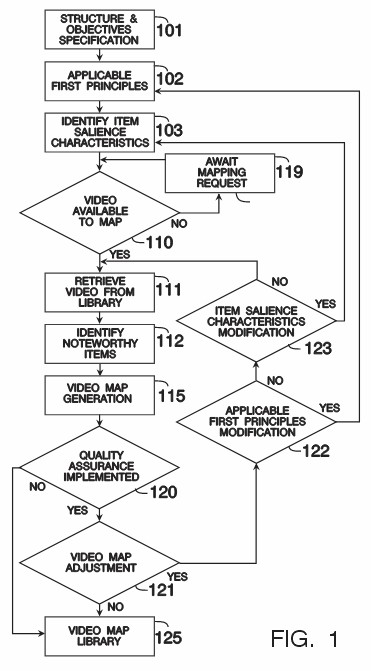
Following identification of item salience characteristics 103, the process evaluates whether a video is available to map at decision point 110. Where no video is available to map, the process proceeds to await mapping request 119 until a video becomes available. Where a video is available to map, the process proceeds to retrieve video from library 111. Responsive to the retrieved video and the identified item salience characteristics 103, the neural network proceeds to identify noteworthy items 112 within the video.
Following identification of noteworthy items 112, the process proceeds to video map generation 115, wherein the neural network generates a video map associating the identified noteworthy items with their video playing locations within the video. Following video map generation 115, the process evaluates whether quality assurance is implemented at decision point 120. Where quality assurance is not implemented, the process proceeds directly to store the video map in video map library 125. Where quality assurance is implemented, the process proceeds to evaluate whether video map adjustment is warranted at decision point 121. Where video map adjustment is not warranted, the process proceeds to store the video map in video map library 125. Where video map adjustment is warranted, the process returns to video map generation 115 for regeneration of the video map responsive to the adjustment.
The process comprises two modification feedback loops operating responsive to the generated video map. At decision point 122, the process evaluates whether applicable first principles modification is warranted. Where applicable first principles modification is warranted, the process returns to applicable first principles 102 with modified first principles, and the neural network re-identifies item salience characteristics 103 and proceeds through the remainder of the process with the modified first principles. Where applicable first principles modification is not warranted, the process proceeds to decision point 123.
At decision point 123, the process evaluates whether item salience characteristics modification is warranted. Where item salience characteristics modification is warranted, the process returns to item salience characteristics 103 with modified item salience characteristics, and the neural network proceeds to identify noteworthy items 112 responsive to the modified item salience characteristics. Where item salience characteristics modification is not warranted, the process proceeds to store the video map in video map library 125. The two modification feedback loops implement a self-correcting refinement mechanism enabling the neural network to improve applicable first principles selection and item salience characteristics identification responsive to video map generation outcomes.
FIG. 2 illustrates a viewer information delivery process. The process begins at viewer video preference 201, wherein a viewer specifies a video preference. The process evaluates whether the video preference is available at decision point 202. Where the video preference is not available, the process returns to viewer video preference 201. Where the video preference is available, the process proceeds to deliver video from library 203.
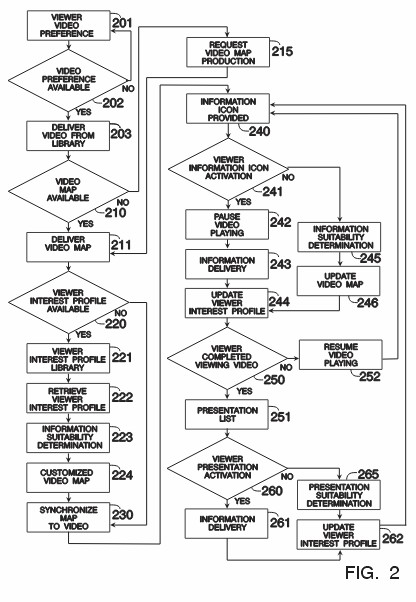
Following delivery of the video, the process evaluates whether a video map is available for the delivered video at decision point 210. Where a video map is not available, the process proceeds to request video map production 215, initiating the video map creation process illustrated in FIG. 1. Where a video map is available, the process proceeds to deliver video map 211.
Following delivery of the video map, 211 the process evaluates whether a viewer interest profile is available for the viewer at decision point 220. Where a viewer interest profile is available, the process proceeds through viewer interest profile library 221 to retrieve viewer interest profile 222. Where a viewer interest profile is available, the process proceeds directly to retrieve viewer interest profile 222. Following retrieval of the viewer interest profile, the process proceeds to information suitability determination 223, wherein the degree of alignment between item salience characteristics recorded in the video map and the viewer interest profile is determined. Responsive to information suitability determination 223, the process proceeds to customized video map 224, wherein the video map is adapted to the viewer interest profile by retaining items meeting the information suitability determination threshold and disabling items not meeting the threshold. The process then proceeds to synchronize video map to video 230, wherein the customized video map is synchronized to the video playback timeline. Where a viewer interest profile is not available 220, the process proceeds to synchronize the non-customized video map to video 230.
Following synchronization, the process proceeds to providing information icon 240, wherein information icons are provided to the viewer during viewing of the video. The process evaluates whether viewer information icon activation has occurred at decision point 241. Where viewer information icon activation has not occurred, the process proceeds to information suitability determination 245, wherein the predicted suitability of the non-activated information is reconciled against the viewer interest profile, and responsive to information suitability determination 245 the process proceeds to update video map 246.
Where viewer information icon activation has occurred at decision point 241, the process proceeds to pausing the video playing 242 and information delivery 243, wherein information associated with the activated noteworthy item is provided. Responsive to information delivery 243, the process proceeds to update viewer interest profile 244, wherein the viewer interest profile is updated responsive to behavioral signals collected during the information delivery interaction, comprising one or more of information engagement, shopping icon activation, shopping icon non-activation, and purchase proximity signal.
The process evaluates whether the viewer has completed viewing the video at decision point 250. Where the viewer has not completed viewing the video, the process resumes video playing 252 and returns to information icon display 240. Where the viewer has completed viewing the video, the process proceeds to presentation list 251, wherein a presentation list derived from the customized video map is provided to the viewer.
Following delivery of the presentation list, the process evaluates whether viewer presentation activation has occurred at decision point 260. Where viewer presentation activation has not occurred, the process proceeds to presentation suitability determination 265, wherein the predicted suitability of non-activated presentations is reconciled against the viewer interest profile. Where viewer presentation activation has occurred, the process proceeds to information delivery 261, wherein information associated with the activated presentation is provided to the viewer, and update viewer interest profile 262, wherein the viewer interest profile is updated responsive to behavioral signals collected during the presentation interaction. Following the updating of the viewer interest profile 262, the process returns to the provision of a next information icon until process termination upon, for example, video playing.
FIG. 3 illustrates a viewer interest profile derivation process. The process receives viewer demographics input 301 and viewer stated preferences input 302 as primary inputs. The process additionally accesses first principles knowledge base 303, from which applicable first principles selection 304 identifies the first principles relevant to viewer interest profile derivation, comprising first principles of consumer psychology, aspiration dynamics, and identity formation.
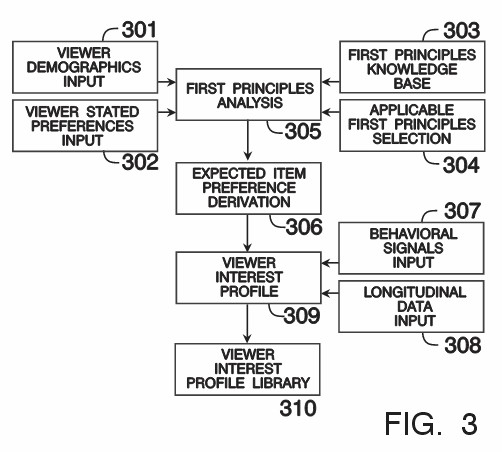
Responsive to viewer demographics input 301, viewer stated preferences input 302, and applicable first principles selection 304, the process proceeds to first principles analysis 305, wherein the neural network applies the selected applicable first principles to the viewer demographics and stated preferences. Responsive to first principles analysis 305, the process proceeds to expected item preference derivation 306, wherein the neural network derives expected item preferences representing the viewer's anticipated receptivity to content items based on the first principles analysis.
Responsive to expected item preference derivation 306, the process integrates behavioral signals input 307 and longitudinal data input 308 to produce viewer interest profile 309. Behavioral signals input 307 comprises signals collected during viewing sessions reflecting viewer engagement with identified noteworthy items. Longitudinal data input 308 comprises data accumulated across prior viewing sessions reflecting the viewer's durable item receptivity characteristics. The integration of expected item preference derivation 306, behavioral signals input 307, and longitudinal data input 308 produces viewer interest profile 309 representing a complete representation of the viewer's receptivity to content items. Viewer interest profile 309 is stored in viewer interest profile library 310 for retrieval during the viewer information delivery process illustrated in FIG. 2.
FIG. 4 illustrates a system architecture 400 comprising a knowledge and data stores subsystem 401, a neural processing subsystem 410, a delivery components subsystem 430, a first screen display device 441, and a companion device 442. Because FIG. 4 illustrates subsystem and component relationships without directional linkage indicators, all data flows, operational dependencies, and inter-component relationships are specified in the following description.
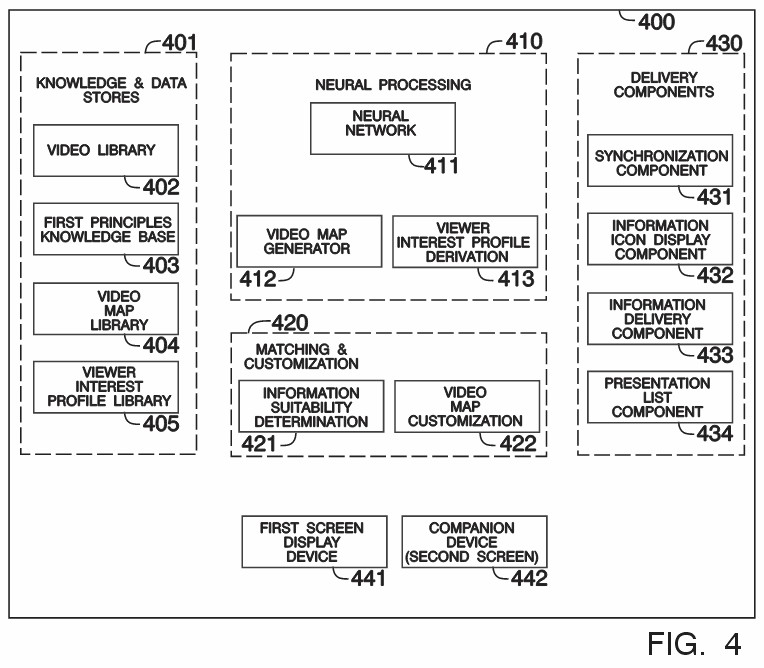
Knowledge and data stores subsystem 401 comprises video library 402, first principles knowledge base 403, video map library 404, and viewer interest profile library 405. Video library 402 stores videos available for processing through the video map creation process illustrated in FIG. 1 and for delivery to viewers, delivering video content to video map generator 412 for video map creation and delivering video content to first screen display device 441 and companion device 442 for presentation to the viewer. First principles knowledge base 403 stores fundamental principles governing item identification within videos and viewer interest profile derivation, comprising first principles of perceptual psychology, narrative semiotics, consumer psychology, and acoustic-visual integration, and delivers applicable first principles to neural network 411 governing all neural network operations including noteworthy item identification, item salience characteristics derivation, and viewer interest profile derivation. Video map library 404 stores video maps generated through the video map creation process illustrated in FIG. 1, receiving generated video maps from video map generator 412 for storage, and delivers stored video maps to information suitability determination component 421 for use in the information suitability determination. Viewer interest profile library 405 stores viewer interest profiles derived through the viewer interest profile derivation process illustrated in FIG. 3, receiving derived viewer interest profiles from viewer interest profile derivation component 413 for storage, and delivers retrieved viewer interest profiles to information suitability determination component 421 for use in the information suitability determination. Viewer interest profile library 405 additionally receives updated viewer interest profile data from first screen display device 441 and companion device 442 responsive to behavioral signals collected during viewing sessions, as described below.
Neural processing subsystem 410 comprises neural network 411, video map generator 412, and viewer interest profile derivation component 413. Neural network 411 is the central processing component of the system, receiving applicable first principles from first principles knowledge base 403, and is configured to identify noteworthy items within videos responsive to applicable first principles, to derive item salience characteristics responsive to applicable first principles, and to govern viewer interest profile derivation operations within viewer interest profile derivation component 413 through applicable first principles of consumer psychology, aspiration dynamics, and identity formation. Neural network 411 delivers noteworthy item identifications and item salience characteristics to video map generator 412 for video map generation and to information suitability determination component 421 for information suitability determination. Video map generator 412 receives video content from video library 402 and noteworthy item identifications and item salience characteristics from neural network 411, and is configured to generate video maps associating identified noteworthy items with their video playing locations within videos, delivering generated video maps to video map library 404 for storage. Viewer interest profile derivation component 413 receives applicable first principles and derivation analysis from neural network 411 and receives viewer demographics and stated preferences from viewer-facing inputs, and is configured to derive viewer interest profiles representing viewer receptivity to content items responsive to the neural network's first principles analysis of viewer demographics and stated preferences, delivering derived viewer interest profiles to viewer interest profile library 405 for storage.
Neural processing subsystem 410 further comprises matching and customization subsystem 420 as a functionally distinct block comprising information suitability determination component 421 and video map customization component 422. Information suitability determination component 421 receives video maps from video map library 404, receives viewer interest profiles from viewer interest profile library 405, and receives noteworthy item identifications and item salience characteristics from neural network 411, and is configured to determine the degree of alignment between item salience characteristics recorded in a video map and a viewer interest profile, generating interest match scores for each noteworthy item and delivering information suitability determination outputs to video map customization component 422. Video map customization component 422 receives information suitability determination outputs from information suitability determination component 421, and is configured to generate a customized video map responsive to the information suitability determination, retaining noteworthy items meeting the information suitability threshold with their interest match scores and removing or deferring items not meeting the threshold, delivering the customized video map to synchronization component 431 and information icon display component 432.
Delivery components subsystem 430 comprises synchronization component 431, information icon display component 432, information delivery component 433, and presentation list component 434. Synchronization component 431 receives the customized video map from video map customization component 422 and receives the current video playing position from the video playback system of the active display device, and is configured to synchronize the customized video map to the video playback timeline, maintaining alignment between the customized video map and the current video playing location within the video being presented, and delivering synchronized video playing location signals to information icon display component 432 governing the timing of information icon providing. Information icon display component 432 receives the customized video map from video map customization component 422 and synchronized video playing location signals from synchronization component 431, and is configured to provide information icons to the viewer during playing of the video at video playing locations corresponding to noteworthy items identified in the customized video map, delivering viewer activation signals to information delivery component 433 upon viewer activation of a provided information icon. Information delivery component 433 receives viewer activation signals from information icon display component 432 and is configured to generate an information delivery responsive to one or more of viewer activation of a provided icon and a viewer information request, delivering one or more of responsive information, map information, global information, subject presentation, and a presentation list to the video display apparatus. Presentation list component 434 receives customized video map data and viewer interaction behavioral signals and is configured to generate and deliver a presentation list derived from the customized video map to the viewer responsive to completion of playing of the video.
System architecture 400 further comprises first screen display device 441 and companion device 442. First screen display device 441 receives video content from video library 402 and receives information icons, information delivery, and the presentation list from delivery components subsystem 430, and operates in a first screen implementation wherein information icons, information delivery, and the presentation list are delivered on the same display device presenting the video. Companion device 442 receives information icons, information delivery, and the presentation list from delivery components subsystem 430, and operates in a second screen implementation wherein information icons, information delivery, and the presentation list are delivered on a companion device separate from the display device presenting the video. Behavioral signals collected during viewing sessions at first screen display device 441 and companion device 442 are transmitted to viewer interest profile library 405 to update viewer interest profiles responsive to viewing session engagement.
FIG. 5 illustrates a viewer information request process. The process begins at viewer video preference 501, wherein a viewer specifies a video preference. The process evaluates whether the video preference is available at decision point 502. Where the video preference is not available, the process returns to viewer video preference 501. Where the video preference is available, the process proceeds to deliver video from library 503.
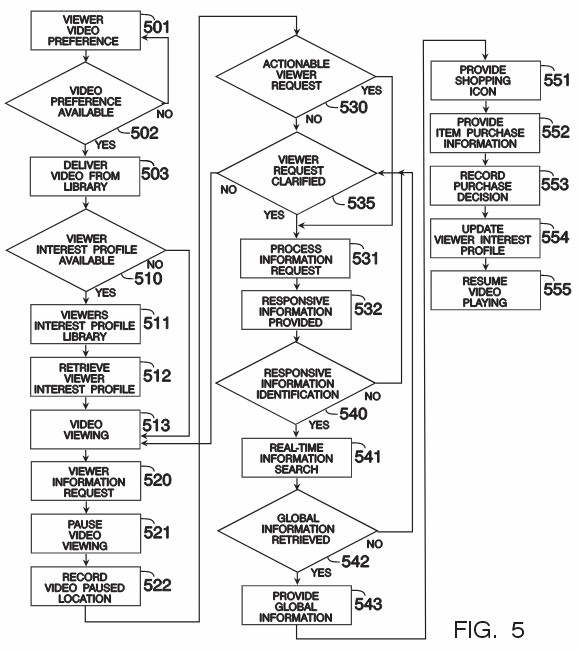
Following delivery of the video 503, the process evaluates whether a viewer interest profile is available for the viewer at decision point 510. Where a viewer interest profile is available, the process proceeds through viewer interest profile library 511 to retrieve viewer interest profile 512. Following retrieval of viewer interest profile 512, the process proceeds to viewing video 513. Where a viewer interest profile is not available, the process proceeds to viewing video 513.
Upon a viewer information request 520, the process immediately proceeds to pause video 521. The process proceeds to capture video paused location, wherein the system records a video paused location 522 corresponding to the moment of the viewer information request 520.
The process evaluates whether the viewer information request is intelligible and actionable at decision point 530. Where the viewer information request is not intelligible or actionable 530, the process proceeds to request clarification 535, wherein the system prompts the viewer to restate or clarify the viewer information request. Where the viewer information request is now intelligible and actionable, the process proceeds to information request processing 531. Where the viewer information request remains not intelligible or actionable, the process proceeds to resume video viewing, wherein video playback resumes at a resume location responsive to a resume condition, and the process returns to viewing video 513.
The process proceeds to information request processing 531, wherein the system provides information 532 responsive to the viewer interest profile if retrieved 512, and the recorded video pause location 522. In an exemplary embodiment, responsive processing of information request 531 applies first principles of perceptual psychology and natural language semantics to resolve the information request against the visual characteristics of the video paused location 522, handling delays between the video paused location 522 and the viewer information request 520, discrepancies resulting from request ambiguity and partial description, and item depiction conditions. The process evaluates whether responsive information identification is suitable 540. Where responsive information identification is not suitable, the process returns to request clarification 530.
Where responsive information identification is suitable 540, the process proceeds to real-time information search 541, wherein the system conducts a real-time information search responsive to the information identification 540. The process evaluates whether the real-time information search 541 has successfully retrieved global information at decision point 542. Where global information has not been successfully retrieved, the process returns to request clarification 535. Where global information has been successfully retrieved 542, the process proceeds to providing global information 543 wherein global information is provided to the video display apparatus.
The process evaluates whether a shopping option should be provided contemporaneously with the provided global information. Where a shopping option is warranted, the process proceeds to provide shopping icon 551. Where the viewer activates the shopping icon, the process proceeds to provide item purchase information 552, record purchase decision 553, update viewer interest profile 554 accordingly, and resume video playing 555. For FIG 5 simplicity, responsive options are not illustrated at various points including whether icon should be provided at 551, whether viewer activates icon to cause item purchase to be provided at 552, responsively recording purchase information whether positive or negative 553 and updating the viewer interest profile 554, and the full options for resuming a video playing 555.
FIG. 6 illustrates an integrated video information delivery process comprising a session initialization, a customized video map generation, a viewing loop, a single integrated delivery sequence, an adaptive update, and a session conclusion. FIG. 6 illustrates the integrated proactive and reactive architectureS of the present invention, wherein both the proactive and the reactive steps operate within a single continuous process reflecting the system's unified architecture.
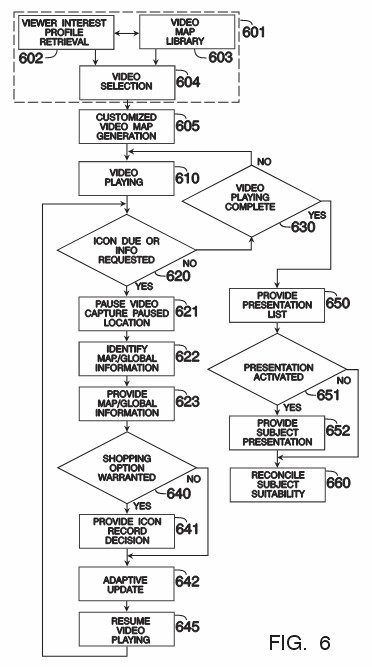
Session initialization block 601 comprises three interdependent components: viewer interest profile retrieval 602, video map library 603, and video selection 604. These three components are mutually dependent and do not operate sequentially but interact as a triangle of interdependent operations governing which video is selected for presentation to the viewer and on what basis. Viewer interest profile retrieval 602 retrieves the viewer interest profile associated with the identified viewer, comprising the viewer's receptivity to content items derived through first principles analysis of viewer demographics, viewer stated preferences, behavioral signals accumulated across prior viewing sessions, and longitudinal data. Where a viewer interest profile is not available for an identified viewer, the system initiates viewer interest profile applying first principles of consumer psychology, aspiration dynamics, identity formation, and economic receptivity to available viewer data to generate an initial viewer interest profile.
Video map library 603 stores video maps generated through a video map creation process where each video map comprises identified noteworthy items within a video, their video playing locations, item salience characteristics, typed salience classifications, and enrichment layer content. Video map library 603 participates in video selection 604 through information opportunity scoring, wherein the video maps of candidate videos are evaluated against the viewer interest profile retrieved at viewer interest profile retrieval 602 to generate an information opportunity score for each candidate video representing the expected density and quality of noteworthy item matches between the candidate video's item salience characteristics and the viewer's interest profile. The information opportunity score is a primary determinant of video selection 604, reflecting the first principles recognition that the commercial value of a video presentation to a specific viewer is a function of the alignment between the video's item salience characteristics and the viewer's receptivity to those items. Where a candidate video does not have an available video map in video map library 603, the system proceeds to initiate video map production through the video map creation process illustrated in FIG. 1 before completing the information opportunity scoring for that candidate.
Video selection 604 selects a video for presentation to the viewer responsive to the viewer interest profile retrieved at viewer interest profile retrieval 602 and the information opportunity scores derived through the interaction of viewer interest profile retrieval 602 and video map library 603, across three selection dimensions. The first selection dimension is recency filtering, wherein videos recently viewed by the identified viewer are excluded from the candidate set responsive to behavioral signals recorded in the viewer interest profile, reflecting the first principles recognition that repeated presentation of recently viewed content generates diminishing viewer engagement and information delivery value. The second selection dimension is preference alignment, wherein candidate videos are evaluated against the viewer's granular first principles-derived preference profile comprising one or more of narrative arc preferences, performer associations, period and setting preferences, tonal preferences, outcome preferences, and content category affinities, surfacing videos whose structural and narrative characteristics align with the viewer's preference architecture at the level of specificity derivable from first principles analysis of the viewer's behavioral signals and stated preferences. The third selection dimension is information opportunity maximization, wherein the video map-derived information opportunity score governs the ranking of candidate videos within the preference-aligned candidate set, selecting the video whose item salience characteristics generate the highest expected value of information delivery to the specific viewer. The interaction between viewer interest profile retrieval 602 and video map library 603 is bidirectional, as indicated by the bidirectional arrows in FIG. 6: the viewer interest profile drives the information opportunity scoring of video maps, and the information opportunity scores of available video maps may in turn refine the viewer interest profile's effective preference weightings responsive to the availability of high-opportunity content.
Following session initialization block 601, the process proceeds to customized video map generation 605, wherein the information suitability determination is performed responsive to the selected video's video map and the retrieved viewer interest profile, generating a customized video map retaining from the video map those noteworthy items whose item salience characteristics meet the information suitability determination threshold for the specific viewer, with each retained item carrying an interest match score representing the degree of alignment between the item's salience characteristics and the viewer's interest profile. The customized video map is synchronized to the playing of the selected video, maintaining alignment between the item video playing locations recorded in the customized video map and the current video playing location within the video as it plays. Following customized video map generation 605, the process proceeds to playing video 610.
Playing the video 610 is the central state of the integrated video information delivery process, representing the state in which the selected video is playing and the system is concurrently monitoring for two classes of trigger event: a proactive trigger comprising a determination that providing an information icon is due responsive to the customized video map and the current video playing location, and a reactive trigger comprising receipt of a viewer information request independently of any provided information icon. The process evaluates at decision point 620 whether either trigger class has been activated. Where neither trigger has been activated, the process evaluates whether the video is complete at decision point 630. Where the video is not complete, the process returns to viewing playing 610. Where the video is complete, the process proceeds via the completion path to session conclusion as described below.
Where either trigger is activated at decision point 620, the process proceeds to pause video and capture video playing location 621, wherein playing of the video is immediately paused and a video playing location is captured corresponding to the moment of the trigger activation, identified by one or more of a time stamp, frame identification, and clip definition. Where the trigger is a proactive trigger, the video playing location corresponds to the video map record for the noteworthy item whose information icon was due for providing, and map information is available from the customized video map. Where the trigger is a reactive viewer information request, the video playing location is captured contemporaneously with the pausing and the system proceeds to identify the subject of the viewer information request responsive to the captured video playing location through responsive information identification applying first principles of perceptual psychology and natural language semantics. In both cases the process proceeds to a single unified delivery sequence regardless of which trigger class activated the event.
The process proceeds to identify responsive information 622, wherein the system identifies the information to be delivered responsive to the video playing location and, where applicable, the viewer information request. The system evaluates whether map information is available and sufficient responsive to the video playing location. Where map information is available and sufficient, map information is retrieved from the customized video map responsive to the video playing location. Where map information is unavailable or insufficient, the system conducts a real-time information search responsive to the viewer information request and the video playing location, retrieving global information through a real-time information search accessing one or more of commercial databases, product catalogs, encyclopedic resources, geographic information systems, cultural and historical archives, news and current events databases, and other external information sources. Where both map information and global information are available, the system prepares a combined information delivery integrating both sources. Global information retrieved through real-time information search is processed prior to delivery responsive to one or more of item salience characteristics, video playing location, spoiler avoidance constraint, enrichment, and viewer interest profile.
The process proceeds to providing information 623, wherein one or more of map information and global information is provided to the video display apparatus responsive to the video playing location and the viewer interest profile. Information delivery comprises one or more of visual presentation on a visual display and auditory presentation through audio reproduction of the video display apparatus. Following information delivery 623, the process evaluates whether a shopping option is warranted at decision point 640, responsive to one or more of the delivered map information, the global information, and the viewer interest profile. Where a shopping option is not warranted, the process proceeds directly to adaptive update 642. Where a shopping option is warranted, the process proceeds to provide shopping icon 641, wherein a shopping icon is provided to the viewer at the conclusion of the information delivery, implementing the sequential information-then-commerce architecture reflecting the first principles recognition that commercial intent is more effectively generated following information delivery than through simultaneous information and commercial presentation.
Following provision of the shopping icon 641, the process records a purchase decision signal responsive to the viewer's engagement with the shopping icon, comprising one or more of purchase completion, purchase initiation, shopping information engagement depth, non-activation, and purchase proximity signal reflecting the depth of viewer engagement prior to non-activation. The purchase decision signal is delivered to adaptive update 642 and to the resume point determination component governing the resume location.
Adaptive update 642 simultaneously updates three system components responsive to the interaction event: the customized video map, the viewer interest profile, and subject presentations. The customized video map is updated responsive to the interaction event to reflect revised information suitability determinations, including icon suppression for items already addressed through a reactive pathway viewer information request, removal of items whose non-activation signals indicate reduced suitability, and reordering of pending items responsive to updated interest match scores. The viewer interest profile is updated responsive to behavioral signals collected during the interaction event, comprising one or more of information engagement depth, shopping icon activation and non-activation, purchase decision signals, purchase proximity signals, and information request subject matter. Subject presentations are updated responsive to the interaction event, incorporating items surfaced through both proactive and reactive pathway interactions into the subject presentation assembly for post-viewing delivery.
Contemporaneously with the adaptive update 642, the process resumes video playing 645. Adaptive update block 660 additionally updates session initialization components via the right-side dashed feedback path, reflecting the continuous updating of the viewer interest profile and the video map library that governs future video selection operations, ensuring that the information opportunity scoring applied in subsequent sessions reflects the viewer's current behavioral engagement history. Resuming the video 645 is responsive to one or more of the purchase decision signal, the duration of the information delivery, the video playing location, clip boundaries, item depiction context, and viewer preference.
Where the video is complete at decision point 630, the process proceeds providing presentation list 650, wherein a presentation list comprising one or more subject presentations organized by presentation category and derived from one or more of the customized video map and viewer information request interactions accumulated during the viewing session through adaptive update 642, ordered responsive to the viewer interest profile by interest match score. The process evaluates whether viewer presentation activation has occurred at decision point 651. Where viewer presentation activation has not occurred, the process proceeds to suitability reconciliation 660, wherein the predicted suitability of non-activated subject presentations is reconciled against the viewer interest profile, updating interest match scores responsive to non-activation behavioral signals. Where viewer presentation activation has occurred, the process proceeds to deliver subject presentation 652, wherein a subject presentation associated with the activated presentation list item is delivered to the viewer, comprising a curated combination of segments extracted from within the video focusing on the presentation of the associated noteworthy item, enabling the viewer to re-encounter the item in its narrative context. Following delivery of subject presentation 652, and subject suitability reconciliation 660, the process proceeds to update viewer interest profile, wherein the viewer interest profile is updated responsive to behavioral signals collected during the subject presentation interaction, further calibrating the viewer's interest profile and economic receptivity assessment for application in future session initialization operations.
FIG. 7 illustrates an integrated system architecture 700 comprising a knowledge and data stores subsystem 701, a neural processing subsystem 710, a video selection subsystem 720, a viewer information request subsystem 730, a matching and customization subsystem 740, a delivery components subsystem 750, an adaptive update block 760, a first screen display device 771, and a companion device 772. Integrated system architecture 700 is the system architecture corresponding to the integrated video information delivery process illustrated in FIG. 6, implementing both the proactive and the reactive pathways within a single unified system. Because FIG. 7 illustrates subsystem and component relationships without directional linkage indicators, all data flows, operational dependencies, and inter-component relationships are specified in the following description.
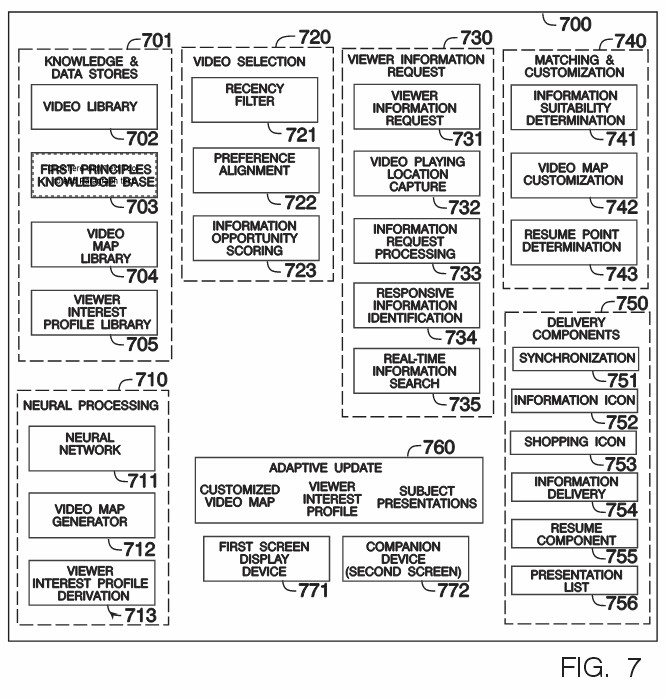
Knowledge and data stores subsystem 701 comprises video library 702, first principles knowledge base 703, video map library 704, and viewer interest profile library 705. Video library 702 stores videos available for delivery to viewers, delivers video content to video map generator 712 for video map creation through the video map creation process illustrated in FIG. 1, delivers the candidate video set to video selection subsystem 720 for recency filtering and selection processing, and delivers video content to first screen display device 771 and companion device 772 for presentation to the viewer. First principles knowledge base 703 stores fundamental principles governing item identification within videos, responsive information identification, and viewer interest profile derivation, comprising first principles of perceptual psychology, narrative semiotics, consumer psychology, social psychology, acoustic-visual integration, natural language semantics, cognitive architecture, and production grammar, and delivers applicable first principles to neural network 711 governing all neural network operations. Video map library 704 stores video maps generated through the video map creation process, delivers stored video maps to neural processing subsystem 710 for reference during responsive information identification, delivers video maps to video selection subsystem 720 for information opportunity scoring, and delivers video maps to matching and customization subsystem 740 for information suitability determination. Viewer interest profile library 705 stores viewer interest profiles derived through the viewer interest profile derivation process, delivers retrieved viewer interest profiles to video selection subsystem 720 for recency filtering and preference alignment, and delivers viewer interest profiles to matching and customization subsystem 740 for information suitability determination. Both video map library 704 and viewer interest profile library 705 receive updated data from adaptive update block 760 and from neural processing subsystem 710 as described below.
Neural processing subsystem 710 comprises neural network 711, video map generator 712, and viewer interest profile derivation component 713. Neural network 711 is the central processing component of integrated system architecture 700, receiving applicable first principles from first principles knowledge base 703 and video maps from video map library 704, and is configured to identify noteworthy items within videos responsive to applicable first principles, to support responsive information identification within viewer information request subsystem 730 through first principles analysis of perceptual psychology and natural language semantics, to support preference alignment evaluation within video selection subsystem 720 through first principles analysis of the viewer's preference architecture, and to govern viewer interest profile derivation operations within viewer interest profile derivation component 713 through applicable first principles of consumer psychology, aspiration dynamics, and identity formation. Neural network 711 delivers noteworthy item identifications and item salience characteristics to information suitability determination component 741, delivers first principles analysis support to responsive information identification component 734, and delivers applicable first principles governing preference dimensionality to preference alignment component 722. Video map generator 712 receives video content from video library 702 and item identification outputs from neural network 711, and is configured to generate video maps associating identified noteworthy items with their video playing locations within videos, delivering generated video maps to video map library 704 for storage. Viewer interest profile derivation component 713 receives first principles governing viewer receptivity derivation from neural network 711 and viewer demographics and stated preferences from viewer-facing inputs, and is configured to derive viewer interest profiles representing viewer receptivity to content items, delivering derived viewer interest profiles to viewer interest profile library 705 for storage and delivering updated viewer interest profile data to viewer interest profile library 705 following behavioral signal integration.
Video selection subsystem 720 comprises recency filter 721, preference alignment component 722, and information opportunity scoring component 723, operating as a sequential pipeline through which the candidate video set is progressively refined to produce the selected video. Video selection subsystem 720 receives the candidate video set from video library 702, receives viewer interest profiles from viewer interest profile library 705, and receives video maps from video map library 704. Recency filter 721 receives the candidate video set from video library 702 and the viewer's viewing history from viewer interest profile library 705, is configured to exclude from the candidate video set videos recently viewed by the identified viewer responsive to behavioral signals recorded in the viewer interest profile, and delivers a recency-filtered candidate set to preference alignment component 722. Preference alignment component 722 receives the recency-filtered candidate set from recency filter 721, receives the viewer's preference profile from viewer interest profile library 705, and receives preference dimensionality analysis from neural network 711, and is configured to evaluate candidate videos against the viewer's granular first principles-derived preference profile comprising one or more of narrative arc preferences, performer associations, period and setting preferences, tonal preferences, outcome preferences, and content category affinities, delivering a preference-aligned candidate set to information opportunity scoring component 723. Information opportunity scoring component 723 receives the preference-aligned candidate set from preference alignment component 722, receives video maps from video map library 704, and receives updated viewer interest profile data from adaptive update block 760, and is configured to evaluate the video maps of preference-aligned candidate videos against the viewer interest profile to generate an information opportunity score for each candidate video representing the expected density and quality of noteworthy item matches between the candidate video's item salience characteristics and the viewer's receptivity profile, ranking the preference-aligned candidate set by information opportunity score and delivering the selected video and associated information opportunity scores to matching and customization subsystem 740 for customized video map generation.
Viewer information request subsystem 730 comprises viewer information request component 731, video playing location capture component 732, information request processing component 733, responsive information identification component 734, and real-time information search component 735. Viewer information request component 731 is configured to receive viewer information requests comprising one or more of a viewer-issued voice command, a viewer-issued text or touch input, a viewer behavioral signal from which information-seeking intent is derivable, and an AI-inferred determination of viewer interest responsive to observed viewer behavior, and upon receipt of a viewer information request, to immediately trigger a video pause command to the video playback system of the active display device, constituting the reactive trigger of the unified trigger architecture. Viewer information request component 731 delivers received viewer information requests to video playing location capture component 732 and to information request processing component 733. Video playing location capture component 732 receives the viewer information request trigger from viewer information request component 731 and receives the current video playing position from the video playback system of the active display device contemporaneously with the pause trigger, is configured to capture a video playing location corresponding to the moment of the viewer information request, and delivers captured video playing locations to information request processing component 733. Information request processing component 733 receives viewer information requests from viewer information request component 731 and captured video playing locations from video playing location capture component 732, is configured to derive an information request responsive to the viewer information request and the captured video playing location, and delivers derived information requests to responsive information identification component 734.
Responsive information identification component 734 receives derived information requests from information request processing component 733, receives first principles analysis support from neural network 711, and queries video map library 704 to evaluate map information availability responsive to the captured video playing location. Responsive information identification component 734 is configured to identify responsive information responsive to the derived information request and the video playing location, applying first principles of perceptual psychology and natural language semantics delivered from neural network 711, handling delays between the video playing location and the viewer information request, discrepancies resulting from request ambiguity and partial description, and item depiction conditions. Where map information is sufficient, responsive information identification component 734 delivers identified responsive information directly to information delivery component 754. Where map information is unavailable or insufficient, responsive information identification component 734 delivers the responsive information identification output to real-time information search component 735. Real-time information search component 735 receives the responsive information identification output from responsive information identification component 734 and is configured to retrieve global information through a real-time information search responsive to the viewer information request where map information is unavailable or insufficient, accessing one or more of commercial databases, product catalogs, encyclopedic resources, geographic information systems, cultural and historical archives, news and current events databases, and other external information sources, and to process retrieved global information prior to delivery responsive to one or more of item salience characteristics, video playing location, spoiler avoidance constraint, enrichment, and viewer interest profile, delivering retrieved and processed global information to information delivery component 754.
Matching and customization subsystem 740 comprises information suitability determination component 741, video map customization component 742, and resume point determination component 743. Information suitability determination component 741 receives video maps and viewer interest profiles from knowledge and data stores subsystem 701, receives the selected video and associated information opportunity scores from video selection subsystem 720, and receives noteworthy item identifications and item salience characteristics from neural network 711, and is configured to determine the degree of alignment between item salience characteristics recorded in a video map and a viewer interest profile, generating interest match scores for each noteworthy item and delivering information suitability determination outputs to video map customization component 742. Video map customization component 742 receives information suitability determination outputs from information suitability determination component 741 and customized video map updates from adaptive update block 760, is configured to generate a customized video map responsive to the information suitability determination retaining noteworthy items meeting the information suitability threshold with their interest match scores, and delivers the customized video map to synchronization component 751 and information icon component 752. The updates received from adaptive update block 760 incorporate icon suppression for items addressed through viewer information request interactions, removal of items whose non-activation signals indicate reduced suitability, and reordering of pending items responsive to updated interest match scores. Resume point determination component 743 receives purchase decision signals from shopping icon component 753, receives information delivery duration and video playing location data from information delivery component 754, and is configured to determine a resume location responsive to a resume condition wherein the resume location is responsive to one or more of a purchase decision signal, the duration of an information delivery, a video playing location, clip boundaries, item depiction context, and viewer preference, delivering determined resume locations to resume component 755.
Delivery components subsystem 750 comprises synchronization component 751, information icon component 752, shopping icon component 753, information delivery component 754, resume component 755, and presentation list component 756. Synchronization component 751 receives the customized video map from video map customization component 742 and receives the current video playing position continuously from the video playback system of the active display device, and is configured to synchronize the customized video map to the playing of the video, maintaining alignment between the customized video map and the current video playing location throughout the playing of the video, and delivering synchronized video playing location signals to information icon component 752 governing the timing of information icon providing during playing of the video. Information icon component 752 receives the customized video map from video map customization component 742 and synchronized video playing location signals from synchronization component 751, and is configured to provide information icons to the viewer during playing of the video at video playing locations corresponding to noteworthy items identified in the customized video map. Upon determining that an information icon is due for providing responsive to the customized video map and the current video playing location, information icon component 752 constitutes the proactive trigger of the unified trigger architecture, immediately triggering a video pause command to the video playback system of the active display device and delivering a viewer activation signal to information delivery component 754, implementing the proactive trigger pathway of the integrated video information delivery process illustrated in FIG. 6. Both the proactive trigger generated by information icon component 752 and the reactive trigger generated by viewer information request component 731 route to the same video pause command and the same delivery sequence within delivery components subsystem 750, establishing the unified trigger architecture in which pathway of origin does not determine the delivery sequence executed.
Shopping icon component 753 receives the information delivery completion signal from information delivery component 754 and the viewer interest profile from viewer interest profile library 705, and is configured to provide shopping icons to the viewer responsive to one or more of delivered information and the viewer interest profile at the conclusion of information delivery, implementing the sequential information-then-commerce architecture of the present invention. Shopping icon component 753 records purchase decision signals comprising one or more of purchase completion, purchase initiation, shopping information engagement depth, non-activation, and purchase proximity signal reflecting the depth of viewer engagement prior to non-activation, delivering purchase decision signals to resume point determination component 743 governing resume location determination and to adaptive update block 760 for viewer interest profile updating. Information delivery component 754 receives responsive information from responsive information identification component 734, receives global information from real-time information search component 735, and receives proactive trigger viewer activation signals from information icon component 752, and is configured to deliver one or more of map information and global information to the active video display apparatus responsive to one or more of a proactive trigger activation of a provided information icon and a reactive trigger viewer information request. Following information delivery, information delivery component 754 delivers an information delivery completion signal and the information delivery duration to shopping icon component 753 to trigger shopping option evaluation, and delivers the information delivery duration and the video playing location to resume point determination component 743 for resume location determination.
Resume component 755 receives determined resume locations from resume point determination component 743, is configured to resume playing of the video at the received resume location responsive to a resume condition, and delivers resume commands to the video playback system of the active display device and delivers resume event signals to adaptive update block 760. Presentation list component 756 receives item identification and interest match score data accumulated across both the proactive pathway and the reactive pathway from adaptive update block 760, is configured to generate and deliver a presentation list derived from one or more of the customized video map and viewer information request interactions during the playing of the video, ordered responsive to the viewer interest profile by interest match score, and delivers the presentation list to one or more of first screen display device 771 and companion device 772 at the conclusion of the viewing session.
Adaptive update block 760 receives interaction event signals from delivery components subsystem 750 across all interaction event types comprising information icon activation, information icon non-activation, viewer information request receipt, shopping icon activation, shopping icon non-activation, purchase proximity signal, resume event, and presentation list engagement, and simultaneously updates three system components responsive to each interaction event. Adaptive update block 760 updates the customized video map by delivering customized video map update instructions to video map customization component 742, incorporating icon suppression for noteworthy items already addressed through reactive pathway viewer information request interactions, removal of items whose non-activation signals indicate reduced suitability, and reordering of pending items responsive to revised interest match scores. Adaptive update block 760 updates the viewer interest profile by delivering updated viewer interest profile data to viewer interest profile library 705, calibrating the viewer's receptivity profile and economic receptivity assessment responsive to behavioral signals collected across both the proactive pathway and the reactive pathway. Adaptive update block 760 updates subject presentations by assembling and maintaining the subject presentation inventory responsive to items surfaced through interaction events across both pathways, delivering accumulated item identification and interest match score data to presentation list component 756 for post-viewing presentation list generation. Adaptive update block 760 additionally delivers updated viewer interest profile data to video selection subsystem 720, ensuring that recency filtering, preference alignment, and information opportunity scoring in subsequent sessions reflect the viewer's current behavioral engagement history.
Integrated system architecture 700 further comprises first screen display device 771 and companion device 772. First screen display device 771 receives video content from video library 702 and the presentation list from presentation list component 756, and operates in a first screen implementation wherein information icons, shopping icons, information delivery, and the presentation list are delivered on the same display device presenting the video. Companion device 772 receives the presentation list from presentation list component 756 and operates in a second screen implementation wherein information icons, shopping icons, information delivery, and the presentation list are delivered on a companion device separate from the display device presenting the video. First screen display device 771 and companion device 772 each comprise one or more of a visual display and audio reproduction. Behavioral signals collected during viewing sessions at first screen display device 771 and companion device 772 are transmitted to adaptive update block 760, comprising information engagement signals, shopping icon activation and non-activation signals, purchase decision signals, purchase proximity signals, and presentation list engagement signals collected across both the proactive pathway and the reactive pathway, enabling the continuous adaptive calibration of the customized video map, the viewer interest profile, and subject presentations that characterizes the integrated video information delivery process of the present invention.